When to Replace Crane Wire Rope: Warning Signs
Know when to replace crane wire rope before a defect stops production. Practical signs, inspection duties and action steps for safer lifts and compliance.
CraneCert · 25 November 2026
A wire rope rarely fails without warning. The warning may be visible as broken wires or crushing, but it can also show up in a rope that no longer sits correctly in the drum, sheave or reeving system. Knowing when to replace crane wire rope is therefore not a matter of waiting for a set date or hoping the next inspection will catch it. It is about recognising deterioration early, removing lifting risk and avoiding a production-stopping breakdown.
For facilities and engineering managers, the decision has two consequences. A rope that remains in service beyond safe limits can put people at risk and lead to a failed LOLER thorough examination. Replacing it too early, without understanding the cause of wear, can add cost while allowing the same fault to damage the new rope.
When should crane wire rope be replaced?
Crane wire rope should be replaced when inspection identifies deterioration that reaches the discard criteria for that rope and application, or when its safe performance is in doubt. There is no universal replacement interval that applies to every overhead crane, hoist or lifting environment.
The answer depends on rope construction and diameter, duty cycle, load spectrum, number of starts, environmental exposure, reeving arrangement, lubrication condition and the condition of associated components. A rope on a lightly used maintenance hoist may remain serviceable for years. A rope on a production crane handling repetitive heavy lifts, abrasive fabrication materials or hot loads may require replacement far sooner.
The manufacturer’s instructions, rope specification and recognised criteria such as ISO 4309 should inform the assessment. In practice, a competent person must consider the rope as a working component within the whole hoisting system, not assess it in isolation.
Visible signs that a crane wire rope may be at discard point
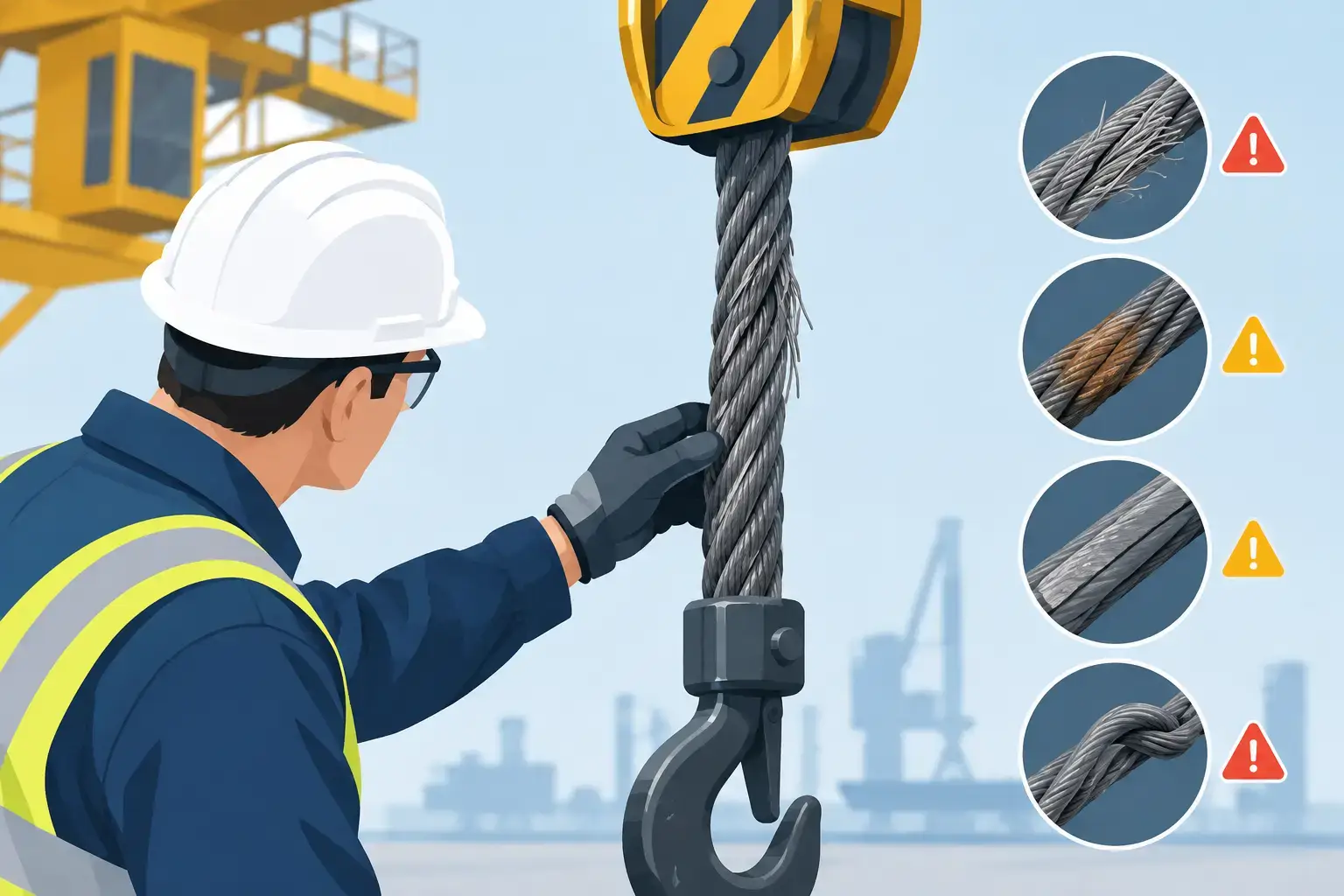
Broken wires are the most familiar warning sign, but they are not the only one. The location, number and concentration of breaks matter. Several broken wires in a short length, or breaks close to an end termination or point of repeated bending, can be more serious than isolated breaks elsewhere on the rope.
A competent inspection should also identify the following conditions:
- corrosion, including internal corrosion hidden beneath surface lubrication;
- abrasion or wear that has reduced the rope diameter;
- crushing, flattening, kinks or birdcaging, where strands open out from the rope core;
- strand displacement, core protrusion or localised distortion;
- heat damage, arc strikes or signs of chemical attack;
- damage at socket terminations, wedge sockets, clamps or drum anchor points.
Birdcaging, kinking and crushing are particularly significant because they permanently alter the rope structure. Lubrication will not correct this damage. Nor should a distorted rope be straightened and returned to service simply because it appears to run again.
Loss of diameter also needs careful attention. A reduced diameter may indicate wear, corrosion or core deterioration. Conversely, a local increase in diameter can point to a damaged core or strand displacement. Both conditions require assessment against the applicable discard criteria.
Do not ignore how the rope is running
The condition of a wire rope is often the symptom rather than the root cause. If a replacement rope is fitted without checking the drum, sheaves and reeving, the new rope may suffer the same damage within weeks.
Watch for rope rubbing against guards or structure, uneven spooling on the drum, cross-winding, a rope jumping from a sheave groove, or excessive vibration under load. These are operational signs that need action, even where the rope has not yet visibly failed a discard measurement.
Sheave grooves should support the rope correctly. A groove that is too tight can pinch and wear the rope. One that is too wide can allow poor support, flattening and instability. Worn sheaves, seized bearings, damaged drum grooves, incorrect fleet angle and misalignment all shorten rope life.
Poor drum spooling is a common issue on overhead cranes. Layers crossing under tension can crush lower wraps, while loose wraps allow the rope to bury into itself when the next lift is made. The rope may look acceptable on the upper layers while damage develops out of sight below. Inspection must include the areas that see the highest bending, crushing and contact stress.
Inspection frequency: planned checks and statutory examination
LOLER thorough examination is a legal control, but it should not be treated as the only opportunity to find wire-rope damage. For lifting equipment used to lift persons, a thorough examination is generally required every six months. For other lifting equipment, it is generally every 12 months, unless a written scheme of examination specifies a different interval. Exceptional circumstances, such as overload, impact damage or a suspected defect, may require an additional examination.
Between thorough examinations, the crane operator and site maintenance team should carry out routine pre-use and planned visual checks. The frequency should reflect the risk and use of the equipment. A high-duty production crane working across multiple shifts needs more attention than an infrequently used workshop hoist.
Routine checks should look for obvious broken wires, corrosion, poor spooling, damage near hook blocks and end terminations, and any change in lifting behaviour. Operators should be encouraged to report unusual noise, jerking, rope movement or difficulty landing the hook accurately. These observations are valuable because they happen during real working cycles, not only while the crane is isolated for inspection.
PUWER also requires work equipment to be maintained in an efficient state, in efficient working order and in good repair. In practical terms, this means having a planned maintenance regime that addresses wire-rope condition before it becomes a statutory failure or breakdown.
What to do when damage is found
If damage is suspected, stop using the lifting motion until the rope has been assessed by a competent person. Do not continue lifting reduced loads as a temporary workaround unless a qualified engineer has specifically confirmed that arrangement is safe. The remaining strength of a damaged rope cannot be judged reliably from a quick visual check.
Record the finding, including its location on the rope, the equipment reference and any operating event linked to the damage. This creates a useful maintenance history and helps establish whether the issue is gradual wear, a one-off incident or evidence of a mechanical fault.
The next step is to inspect the full rope path. This includes the drum, sheaves, equaliser pulleys, hook block, limit devices and rope terminations. Check for alignment, groove wear, bearing condition and evidence that the rope has been running under abnormal tension. If the rope has been exposed to overload, shock loading, heat or chemical contamination, the assessment should account for that event even if surface damage appears limited.
When replacement is required, specify the correct diameter, construction, grade, lay direction and finish for the crane or hoist. A rope that looks similar is not necessarily a suitable substitute. Incorrect rope selection can affect drum winding, pulley compatibility, fatigue performance and safe operation.
After fitting, the rope must be correctly reeved, anchored and tensioned. Limit switches and safe hook travel should be checked, and the rope should bed in under controlled use. Records should show what was fitted, when, by whom and any associated repairs completed.
Why planned replacement protects production
An emergency rope failure does not only take one crane out of service. It can stop a fabrication bay, delay despatch, disrupt maintenance work and leave materials stranded in the wrong part of the site. It can also force a rushed repair decision, when access, parts availability and production pressure are all working against you.
Planned maintenance creates a better option. Trending rope condition across inspections allows replacement to be scheduled around shutdowns, lower-demand periods or planned engineering work. It also gives time to source the correct rope and rectify the drum or sheave condition that caused the wear.
For sites with several cranes, maintain a clear asset register showing rope details, inspection findings, replacement history and due dates for LOLER thorough examinations. Cloud-managed records make this information easier to retrieve during an audit and help managers identify repeat faults across similar equipment.
Make the replacement decision before the next lift makes it for you
A crane wire rope is a safety-critical component, not a consumable to run until it visibly gives up. Broken wires, deformation, corrosion, diameter changes and poor running behaviour all demand a competent assessment. Equally, a rope that appears worn prematurely should trigger investigation of the hoist mechanism around it.
If your team has identified a concern, isolate the equipment, protect the area and arrange an inspection promptly. CraneCert supports planned rope inspections, repairs and replacement work across Yorkshire, the Midlands and the North of England, helping sites keep lifting safely while maintaining the records needed to demonstrate control.