Auxiliary hoists
A second lifting point for load turning, tooling or lower-capacity handling.

Capacity, duty and hook height
Higher-capacity crane systems for demanding duty cycles, long spans and applications where hook approach matters.
Designed around the application
Capacity, span, headroom, duty, structure, controls and maintenance access are considered together.
Choosing the right crane
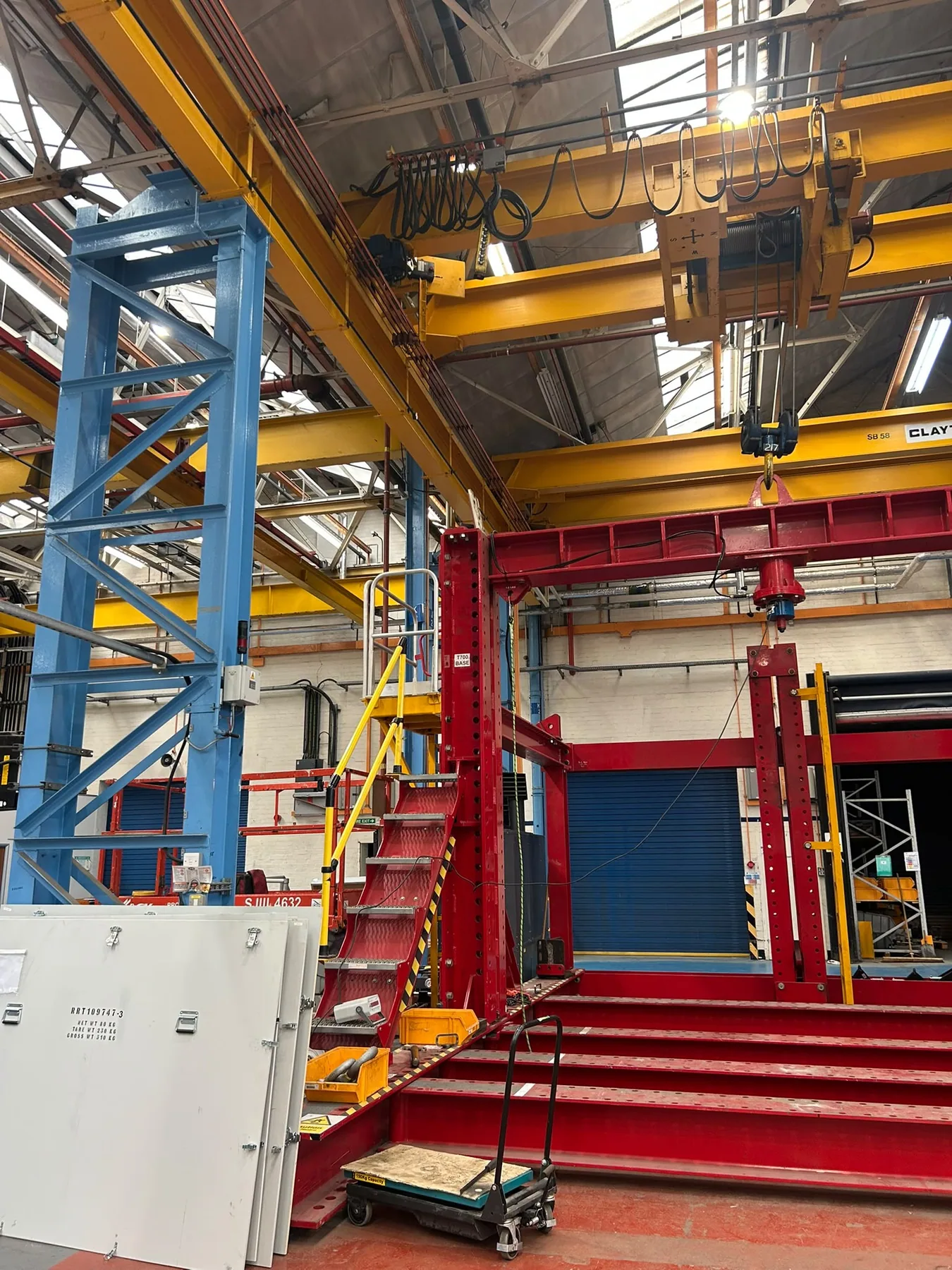
Double girder cranes use two bridge beams with a travelling crab or trolley above or between them. That creates more room for higher capacities, demanding duty classifications and improved hook approaches.
We engineer the complete system around the building, runway reactions, maintenance access and production duty. Walkways, auxiliary hoists and specialist controls can be incorporated where the process needs them.
The design brief
A useful quotation starts with the operating requirement, not just a headline safe working load.
Load weight, shape and centre of gravity
Required duty classification and utilisation
Span, runway length and allowable wheel loads
Top and side hook approaches
Maintenance access and rescue strategy
Process controls, interlocks and collision risks
Configuration options
A second lifting point for load turning, tooling or lower-capacity handling.
Designed access for inspection and maintenance where the site arrangement requires it.
Control strategies for tandem cranes, twin hoists or long and awkward loads.
Request a survey
Share what you know. If capacity, span or hook height are still uncertain, we will help establish them during the survey.
Questions, answered
Double girder layouts are suited to higher capacities, heavier duty and projects where hook height, approach or specialist equipment cannot be achieved efficiently with one beam.
Possibly. We calculate crane and wheel loads and work with the project structural engineer so the runway and supporting building are assessed properly.
Often, but the runway geometry, rail, buffers and structural capacity must be surveyed before a replacement is specified.
Single Girder Overhead Cranes
A practical, economical overhead crane layout for workshops, production bays and routine material handling.
Gantry and Portal Cranes
Freestanding gantry and portal cranes for buildings or yards where roof-supported runways are unsuitable.
Jib Cranes for Workshops and Production
Compact slewing cranes for machines, workstations and production cells where a full bay crane is unnecessary.
Free crane planning pack
Get the practical worksheet our engineers use to start a crane conversation: capacity, span, hook height, duty, access, controls and compliance handover.
Talk through the load, building and timescale with a CraneCert engineer.