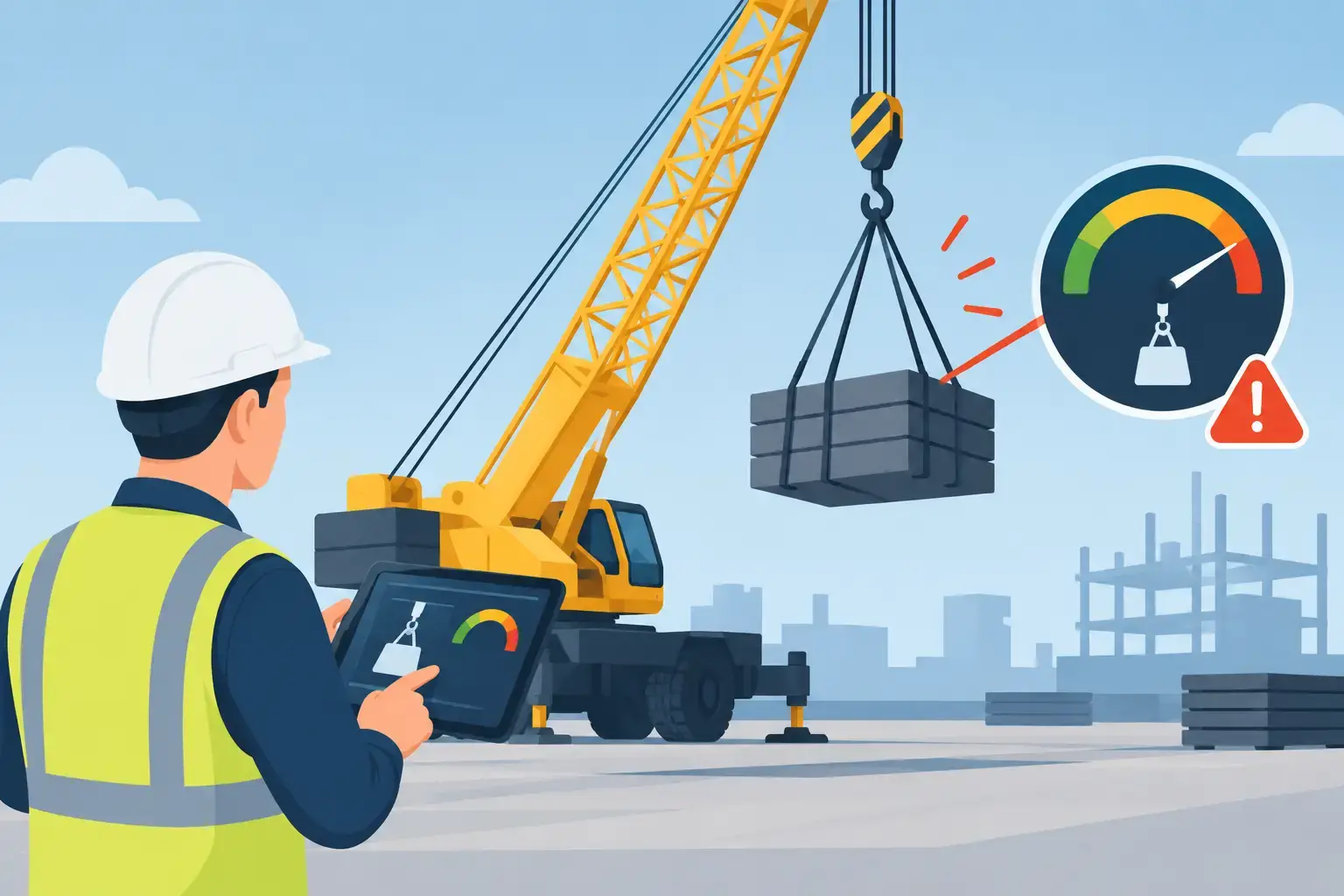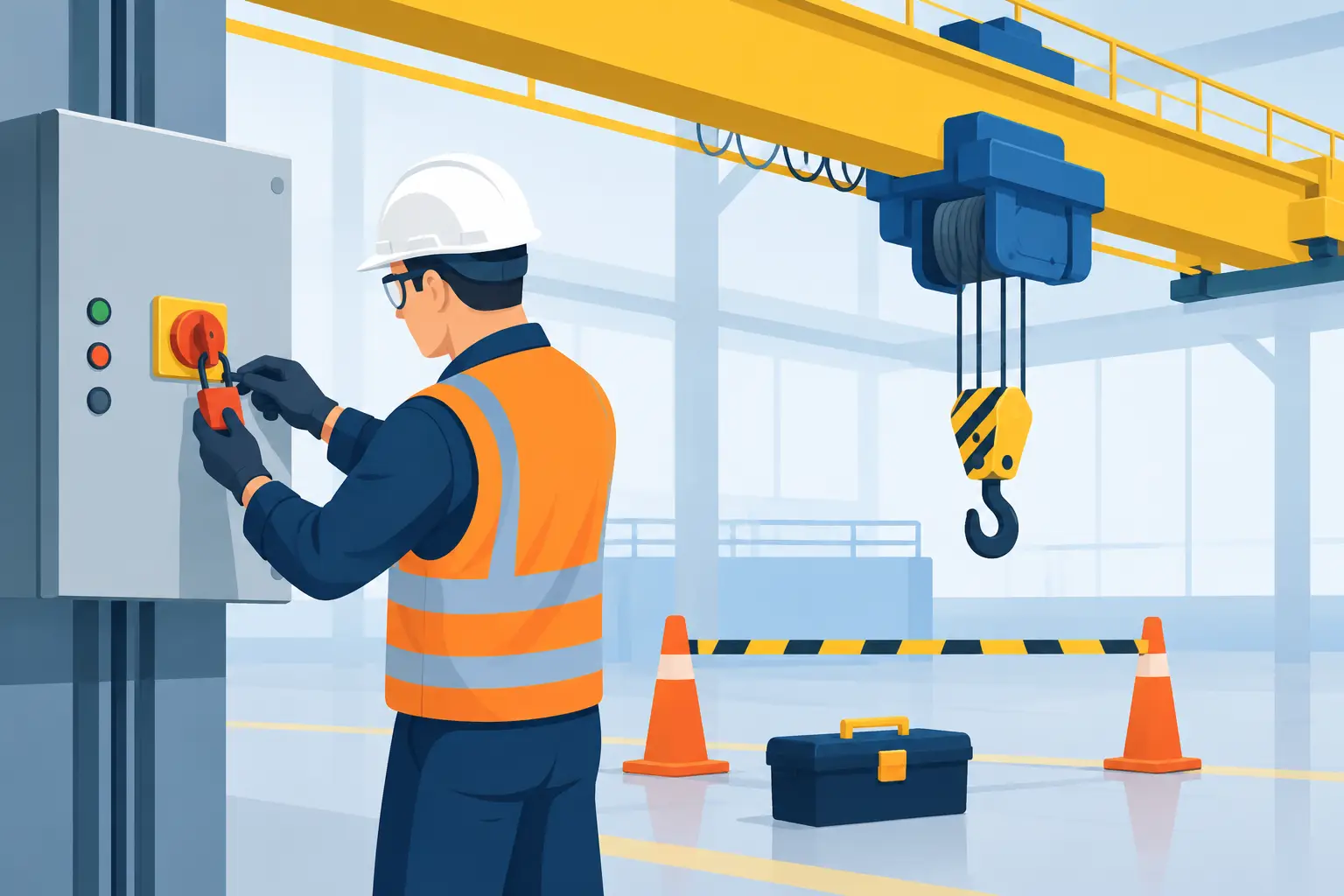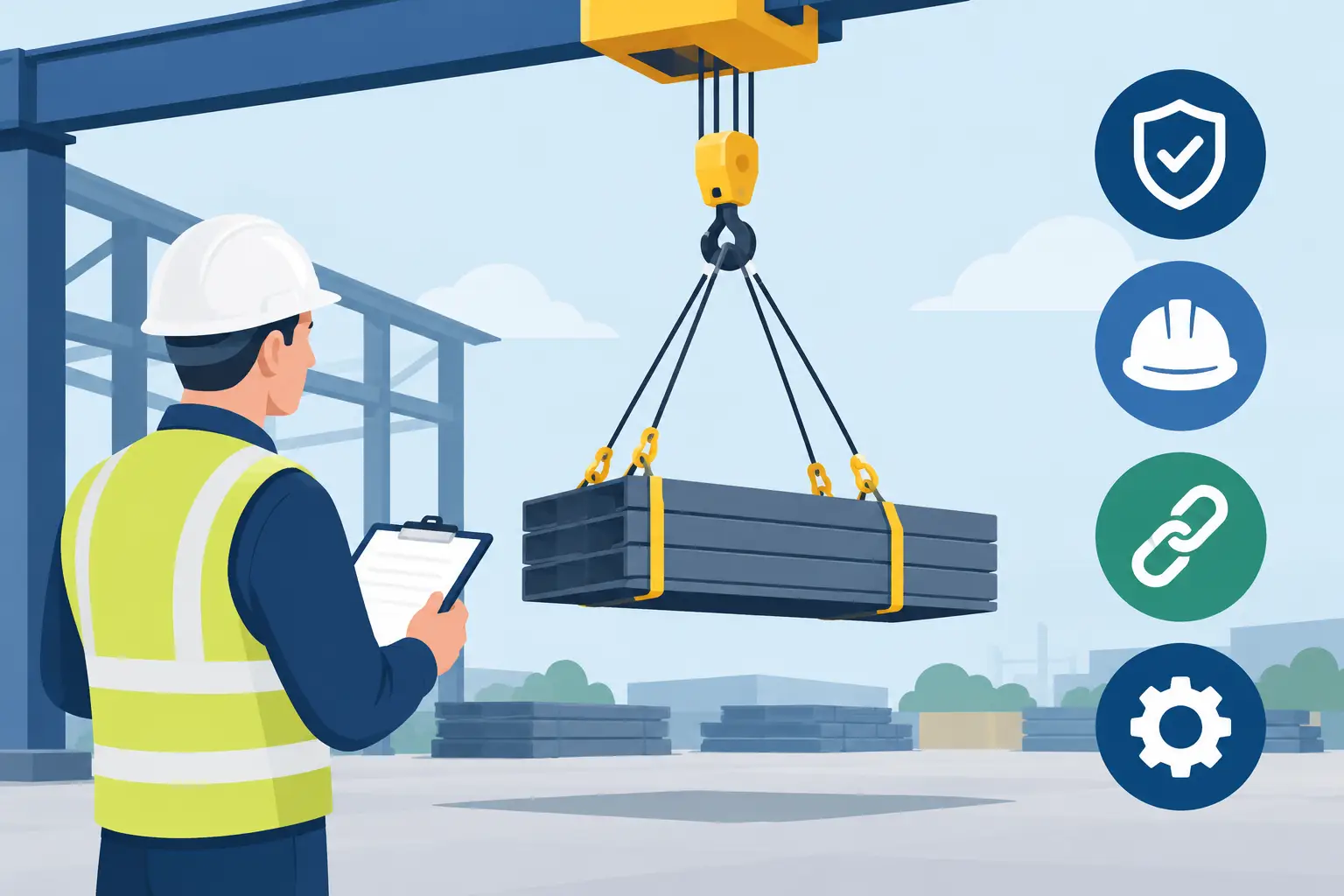
Industrial Hoist Maintenance Guide for Safer Lifting
Use this industrial hoist maintenance guide to reduce downtime, support LOLER and PUWER compliance, and keep lifting operations safe and productive daily.
CraneCert · 23 November 2026
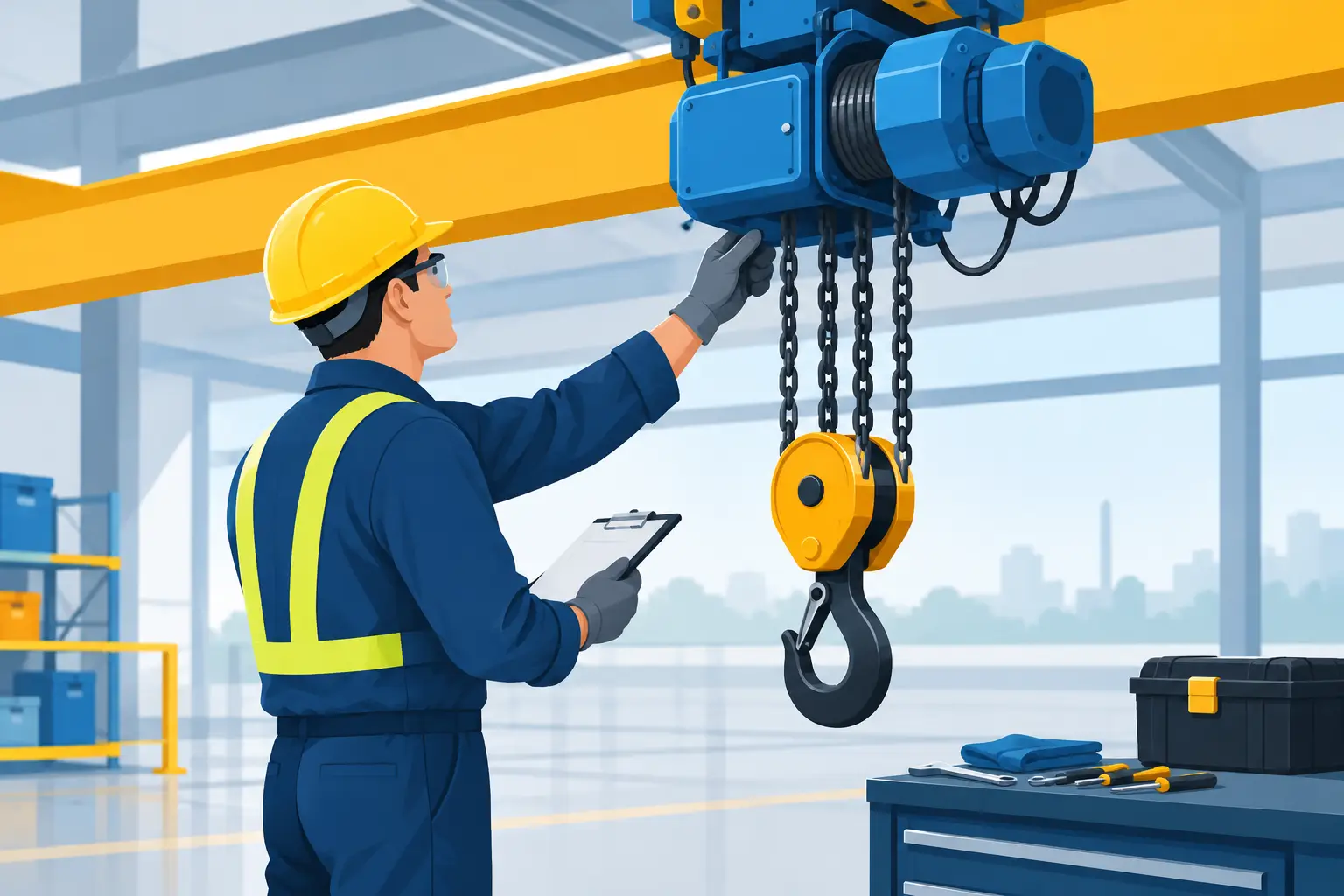
A hoist rarely fails at a convenient time. It fails when a fabrication bay is waiting for steel, a production line needs a die change, or a lorry is booked for collection. This industrial hoist maintenance guide sets out how facilities and engineering teams can control that risk through practical checks, planned servicing and clear compliance records.
The aim is not simply to keep the hoist running. It is to protect people beneath and around the load, prevent costly secondary damage, and ensure your business can demonstrate control when an auditor, insurer or enforcing authority asks for evidence. A working hoist is not automatically a safe or compliant hoist.
Industrial hoist maintenance guide: start with risk and duty
Every maintenance plan should reflect how the equipment is actually used. A chain hoist lifting occasional maintenance items in a quiet workshop needs a different level of attention from a wire-rope hoist completing repeated production lifts over two shifts. Capacity matters, but duty cycle, load spectrum, environment, operator behaviour and the consequences of failure matter just as much.
Start by identifying the hoist type, safe working load, manufacturer, serial number, age, installation arrangement and operating history. Record whether it runs on a monorail, jib crane, overhead travelling crane or gantry. This creates the baseline for a service plan and makes it easier for an engineer to identify the correct parts, settings and inspection requirements.
Under PUWER, work equipment must be suitable, maintained in an efficient state and used by trained people. LOLER adds specific requirements for lifting equipment, including thorough examination at prescribed intervals or in accordance with a written scheme of examination. These duties overlap, but they are not interchangeable.
A LOLER thorough examination assesses whether the lifting equipment remains safe to use. Planned maintenance addresses wear, adjustment, lubrication and developing faults before they become a safety issue or a breakdown. Relying on a six or twelve-month examination alone is a common and expensive mistake.
Build checks into normal operations
Operators are often the first people to notice a change in lifting equipment. A daily pre-use check should be quick enough to happen, but specific enough to identify a reason to stop using the hoist. It is not a substitute for engineering maintenance, and operators should never be expected to dismantle or adjust equipment.
Before use, the operator should look for obvious damage, loose fixings, oil leakage, distorted hooks, worn chain or rope, damaged pendant controls and unreadable markings. They should also test the emergency stop and observe whether the hoist raises, lowers and travels smoothly without abnormal noise, vibration, drift or hesitation.
The following conditions justify taking the equipment out of service and reporting it immediately:
- A hook safety catch is missing, damaged or does not close properly.
- Chain links are stretched, twisted, cracked, corroded or running unevenly over the pockets.
- Wire rope shows broken wires, kinks, crushing, birdcaging or signs of poor winding on the drum.
- The brake slips, the limit switch does not stop travel correctly, or controls respond unpredictably.
- The hoist has received a shock load, collided with another object, or been involved in a near miss.
Do not allow production pressure to turn a defect into an informal acceptance of risk. Tag the hoist clearly, isolate it where appropriate, and arrange competent inspection or repair. A short controlled stoppage is preferable to a dropped load, injury investigation and extended loss of production.
What planned hoist maintenance should cover
A competent service visit goes beyond a visual look-over. The engineer should assess the lifting mechanism, electrical controls, safety devices and supporting arrangement against the manufacturer’s requirements and the equipment’s condition in service.
For an electric chain hoist, this typically includes checking chain wear and lubrication, chain wheel pockets, guide plates, chain collector, hook block, gearbox, brake condition, motor operation, contactors, pendant cable and upper and lower limit switches. The hook should be checked for deformation, throat opening, cracks and free rotation where applicable.
For a wire-rope hoist, rope condition and drum winding require close attention. Engineers should inspect the rope for wear and damage, assess the drum grooves and rope guide, check sheaves, verify the condition of the wedge socket or termination, and examine the gearbox, brake and load path. Poor rope winding can quickly damage both the rope and drum, particularly where operators repeatedly side-pull or allow slack rope to develop.
Electrical checks should include the condition of cables, terminals, earthing, isolators, controls and protective devices. On crane-mounted hoists, the inspection should extend to the trolley, end stops, festoon system or conductor arrangement, and the interface between hoist and crane. A hoist cannot be treated as a standalone item if faults elsewhere in the system affect safe operation.
Lubrication needs care. Over-lubrication attracts dust and abrasive debris, while the wrong lubricant can affect braking surfaces or fail to protect the chain correctly. Follow the manufacturer’s specification rather than applying a general workshop lubricant.
Set a frequency that matches the work
There is no honest one-size-fits-all maintenance interval. The correct frequency depends on use and risk. A lightly used hoist in a clean, dry workshop may need less frequent servicing than the same model operating in dust, heat, moisture, chemical exposure or a high-duty production environment.
As a practical starting point, review usage with your service provider and set planned visits around operating hours, number of lifts, load severity and environmental conditions. Increase the frequency where the hoist handles loads close to its safe working load, performs repetitive lifts, works outdoors, or supports a process where breakdown causes significant disruption.
Also review the plan after any major change. New shifts, heavier product, altered lifting routes, a change in operator team or relocation of equipment can invalidate assumptions made when the service interval was first set. This is particularly relevant for older hoists that have been reliable for years but are now being pushed harder to meet increased output.
Control the causes of premature wear
Many hoist faults start with operating practice rather than component age. Side pulling is a frequent example. It places unwanted force on the chain or rope, hook block, trolley and limit devices, and can cause the load to swing dangerously. The hoist should be positioned directly above the load before lifting.
Shock loading is another concern. Snatching a load, lifting against a snag, or using the hoist to pull rather than lift can overload components even if the stated load weight is within capacity. Operators should lift smoothly, keep clear communication during tandem or guided lifts, and never use a hoist with an uncertain load weight.
Training should cover the equipment’s limits, but also the practical signs of deterioration. When operators understand why a noisy brake, rough chain movement or intermittent pendant matters, defects are more likely to be reported before they create downtime.
Keep records that stand up to an audit
A maintenance record is only useful if it gives you control. It should identify the asset, date, engineer, work completed, defects found, parts replaced, tests carried out and any actions still outstanding. Where a defect affects safety, the record must make the equipment status unmistakable.
Keep planned maintenance reports separate from LOLER thorough examination reports, while ensuring both sit against the same identifiable asset record. This prevents a common audit problem: a site can show that an examination took place, but cannot prove defects were repaired or that the hoist has been maintained between examinations.
Cloud-managed certification can make this process simpler, particularly across multiple sites or departments. The value is not the software alone. It is the ability to produce current documentation quickly, track remedial actions, see upcoming examination dates and avoid certificates expiring unnoticed.
Know when repair is no longer the best option
Not every ageing hoist should be repaired indefinitely. Repeated brake faults, obsolete electrical components, poor parts availability, excessive rope or chain wear, and increasing call-out frequency can indicate that replacement or upgrade is the more commercially sound decision.
The decision depends on downtime exposure and remaining service life, not just the immediate repair price. A lower-cost repair may be justified for a lightly used hoist with readily available parts. For a production-critical unit, installing a modern replacement during a planned shutdown may offer better reliability, improved controls and a more predictable cost base.
An experienced lifting-equipment provider can assess the full picture, including capacity, headroom, duty class, controls, access for maintenance and the condition of the supporting crane. CraneCert supports planned servicing, repairs, upgrades and compliance management across a wide range of hoist and crane makes.
The most effective maintenance plan is the one your team can follow under pressure: clear pre-use checks, competent planned servicing, immediate defect control and records that prove what happened. Put that control in place before the next critical lift, not after the first avoidable breakdown.