Crane Isolation Procedure for Safe Maintenance
A practical crane isolation procedure for safe maintenance, legal compliance and controlled return to service, protecting people and production uptime.
CraneCert · 19 November 2026
A crane that appears to be stopped can still travel, hoist or release stored energy. That is why a crane isolation procedure must do more than press an emergency stop or switch off a pendant. Before maintenance, repair, inspection or cleaning begins, the equipment must be placed in a proven safe condition that prevents unexpected movement and protects the people working on or beneath it.
For a production site, this is also a continuity issue. An uncontrolled isolation can stop the wrong bay, disrupt adjacent lifting operations or leave a crane unavailable longer than necessary. A planned, documented approach keeps the work safe while giving operations a clear route back to service.
Why crane isolation needs a site-specific plan
There is no single switch-off method that suits every overhead crane. A small jib crane may have a local fused isolator. A double-girder overhead travelling crane may have a main electrical supply, a conductor system, a radio-control receiver, separate hoists, festoon-fed equipment and shared runway access. Age, modifications and the original installation design all affect the correct method.
The isolation must therefore be based on the crane's electrical drawings, operating instructions, site risk assessment and the task being completed. It should form part of a written safe system of work, with clear responsibility for the authorised person carrying it out.
LOLER and PUWER do not provide a one-page crane isolation checklist, but they require lifting equipment and work equipment to be safe, properly maintained and used by competent people. A defensible procedure demonstrates control. It also gives maintenance teams, contractors and auditors a clear record of how the risk of unexpected energisation was managed.
An emergency stop is not normally an isolation device. It is designed to stop a hazardous movement quickly, not necessarily to secure all energy sources for maintenance. Likewise, parking a crane at one end of the runway does not make it safe to work on, particularly where another crane can enter the same working area.
Crane isolation procedure: the safe sequence
The exact sequence must be approved for the crane and task. The following framework is a practical starting point for facilities and engineering managers developing or reviewing a procedure.
1. Plan the task and control the area
Start with what work is required, where it will take place and what could move or become live. Identify the crane, runway, hoist, control method and all potential energy sources. Consider adjacent cranes on the same runway, equipment below the work area, pedestrian routes and production activities that may be affected.
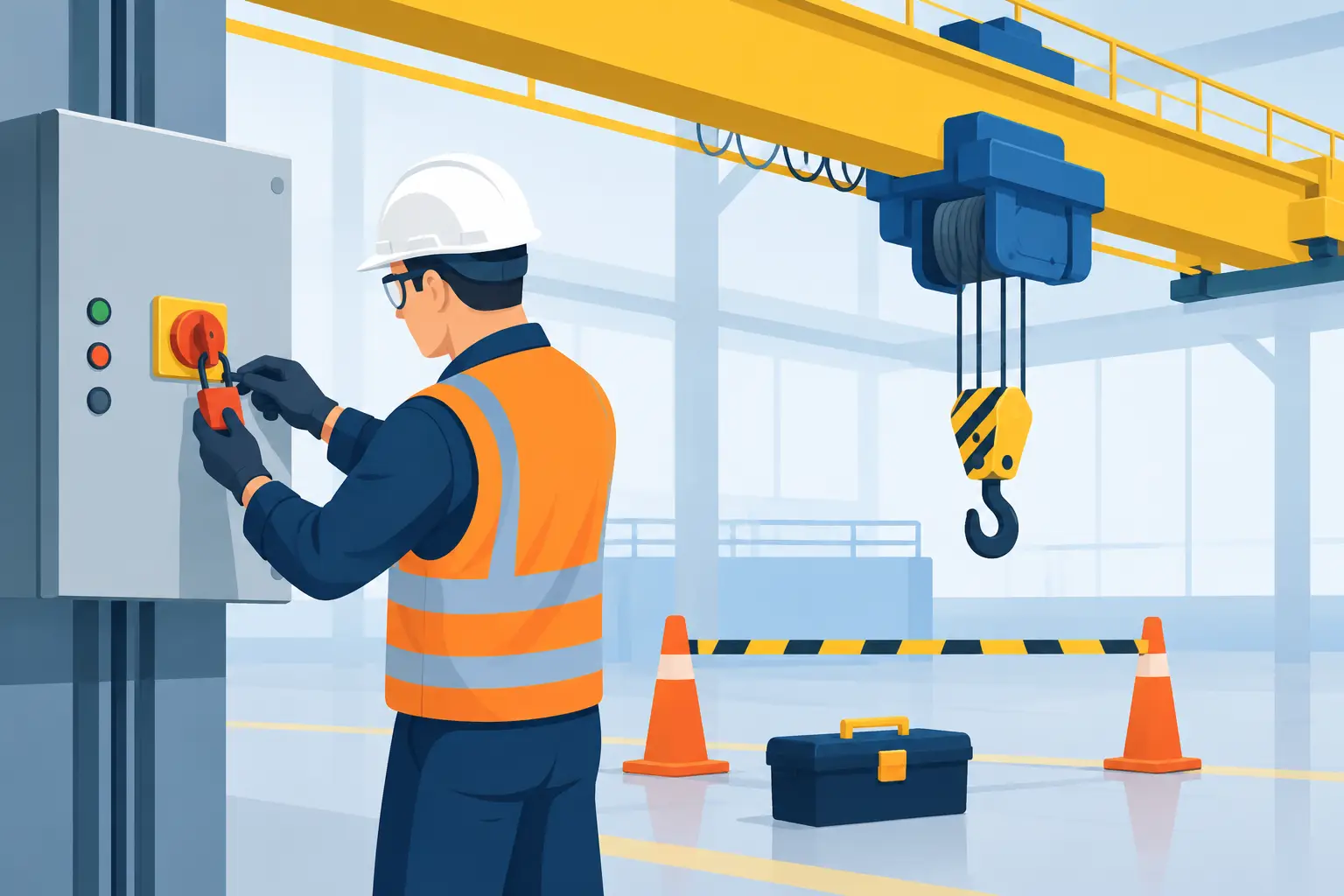
The lifting area should be controlled before isolation starts. Remove any suspended load and position the hook block and trolley in the safe location stated by the site procedure. Barricades, signs and a brief to affected operators help prevent someone attempting to use the crane or entering a restricted area.
Where work is at height, the isolation plan should sit alongside the access method and rescue arrangements. Isolating a crane does not remove the risks associated with a MEWP, ladder access or work near a live conductor system.
2. Notify everyone who could be affected
Tell crane operators, shift supervisors, maintenance staff and contractors what is being isolated, why, when and for how long. On busy sites, a handover between shifts is a common failure point. The oncoming team must know that the crane is out of service and must not be re-energised.
If the crane supports a critical process, agree the outage window with production before the work begins. This avoids pressure to shorten the isolation or return a crane to use before safety checks are complete.
3. Stop the crane and make the load path safe
Bring the crane to a normal controlled stop. Do not rely on stopping equipment by operating a protective device unless there is an emergency. Ensure there is no load suspended, no lifting accessory left under tension and no material that could fall or shift when power is removed.
The correct parked position depends on the task. For electrical work on a runway conductor system, for example, location is critical. For hoist maintenance, the hook block must be secured in the position specified by the method statement. The aim is not simply to make the crane inaccessible. It is to remove foreseeable movement and falling-object risks.
4. Isolate every relevant energy source
Operate the designated isolator or isolators to disconnect the crane from its supply. This may include the crane main isolator, a local hoist isolator, a separate radio-control supply or equipment linked to external systems. On some installations, an isolator on the ground does not isolate the full crane supply. Confirm the actual isolation point from drawings and labels rather than assumptions.
Apply a personal lock and warning tag to each isolation point, or use an approved group lock-box arrangement where several people are working. Each person exposed to the hazard should retain control of their own lock. Tags should identify who applied the isolation, the date, the reason and a contact number or department.
Where stored energy exists, make it safe. This can include electrical energy held in components, hydraulic or pneumatic pressure on ancillary equipment, spring force, gravity and mechanical movement. The method will vary by crane design. It must be defined by a competent person, not improvised at the point of work.
5. Prove the crane cannot operate
Isolation is not complete until it has been verified. The authorised person should check, using the approved safe method, that the crane cannot be operated from its normal controls and that the relevant circuits are dead before electrical work starts. This verification should be performed by a competent person using suitable test equipment where electrical hazards are present.
Do not treat a failed pendant command as proof that all supplies are isolated. A faulty control, flat radio battery or disabled drive can produce the same result while parts of the system remain live. Verification must confirm the condition that matters for the planned work.
For shared runways, verify that adjacent cranes cannot enter the work zone. This may require isolating another crane, fitting physical runway stops where engineered and authorised, or establishing an exclusion arrangement with a dedicated controller. The appropriate control depends on crane layout and the work scope.
6. Record the isolation and complete the work
Record the equipment identity, isolation points, locks applied, people involved, time of isolation and permit reference where a permit-to-work system is used. A simple, consistent record is valuable after a shift change, an incident or an audit.
Carry out only the work covered by the task plan. If the job expands from a brake adjustment to electrical fault-finding, pause and reassess. Additional work may introduce a different energy source, access hazard or requirement for specialist competence.
7. Return the crane to service under control
Restoration deserves the same discipline as isolation. First, confirm that tools, test equipment, temporary restraints and waste have been removed. Guards, covers and safety devices must be reinstated. Check that nobody remains in the danger area and that all affected people understand the crane is about to be energised.
Each individual should remove their own personal lock. Locks must never be removed casually on behalf of an absent worker. Where an exceptional lock-removal process is needed, it should be controlled by site management, documented and carried out only after the person's safety has been confirmed.
Re-energise the crane in accordance with the site procedure, then carry out functional checks appropriate to the work completed. This may include hoist, trolley and long-travel motions, brakes, limit switches, pendant or radio controls and emergency-stop function. A repair that affects safety-critical components may require further inspection or a thorough examination before the crane is returned to normal lifting duty.
Common isolation failures that create real risk
Most failures are not caused by a lack of intent. They happen when a team assumes a familiar crane is wired like another one, overlooks a second feed, relies on an emergency stop, or fails to manage an adjacent crane. Poor labelling is another recurring issue, particularly on older installations that have been altered over time.
There is also a commercial risk in informal practice. If an incident occurs, it is difficult to demonstrate compliance when no one can show which equipment was isolated, who authorised it or how the safe condition was verified. Clear isolation points, current drawings and disciplined records reduce that exposure.
Keep isolation arrangements current
A procedure written when a crane was installed can become outdated after upgrades, radio-control conversions, new runway equipment or changes to the production layout. Review the procedure after significant modification, recurring faults, near misses and changes to access arrangements. Make sure labels match drawings and that authorised staff receive practical refresher training.
Planned maintenance visits are a good opportunity to identify unclear isolators, damaged enclosures, missing warning labels and obsolete documentation before they become a problem. CraneCert can support this work as part of a wider maintenance and compliance programme, giving sites clearer records and a safer route to planned repairs.
The best crane isolation procedure is the one your team can follow without hesitation at 2am during a breakdown: specific to the equipment, clear about who is in control and proven before anyone starts work.