Best Crane Safety Upgrade Options for Safer Lifting
Compare the best crane safety upgrade options for ageing overhead cranes, reduce lifting risk, protect output and keep LOLER and PUWER records audit-ready.
CraneCert · 13 November 2026
An overhead crane does not need to be at the end of its working life to become a safety concern. A slow brake response, poor pendant position, unreliable limit switch or an operator working around blind spots can all increase lifting risk long before the crane fails a thorough examination. The best crane safety upgrade options address the hazards that affect your people and production now, while extending the useful life of a proven asset.
For facilities with ageing lifting equipment, an upgrade can often be more commercially sensible than replacement. That said, safety devices cannot compensate for structural defects, severe corrosion, worn wheels or an inadequately maintained hoist. Start with a competent assessment of the crane, runway, hoist, controls and duty cycle, then choose upgrades that resolve identified risks and support continued compliance.
Start with the risks in your lifting operation
The right upgrade depends on how the crane is actually used. A fabrication bay handling long steel sections faces different risks from a warehouse crane repeatedly loading machinery or a maintenance jib crane used only occasionally. Capacity alone is not enough to make the decision.
Review where operators stand during a lift, whether the load travels over people or production equipment, how often two cranes work in the same bay, and whether the hook approaches its travel limits. Also consider visibility, shift patterns, load types and the consequences of an unplanned stoppage. A crane that is safe in principle may still be difficult to operate safely at the pace your operation requires.
LOLER requires lifting equipment to be strong and stable enough for its intended use, properly marked and thoroughly examined at the appropriate intervals. PUWER adds duties around suitability, maintenance, inspection, controls and training. A documented upgrade plan, supported by inspection and maintenance records, helps demonstrate that risks are being actively managed rather than left until the next breakdown.
Best crane safety upgrade options for overhead cranes
Radio remote controls and improved pendant stations
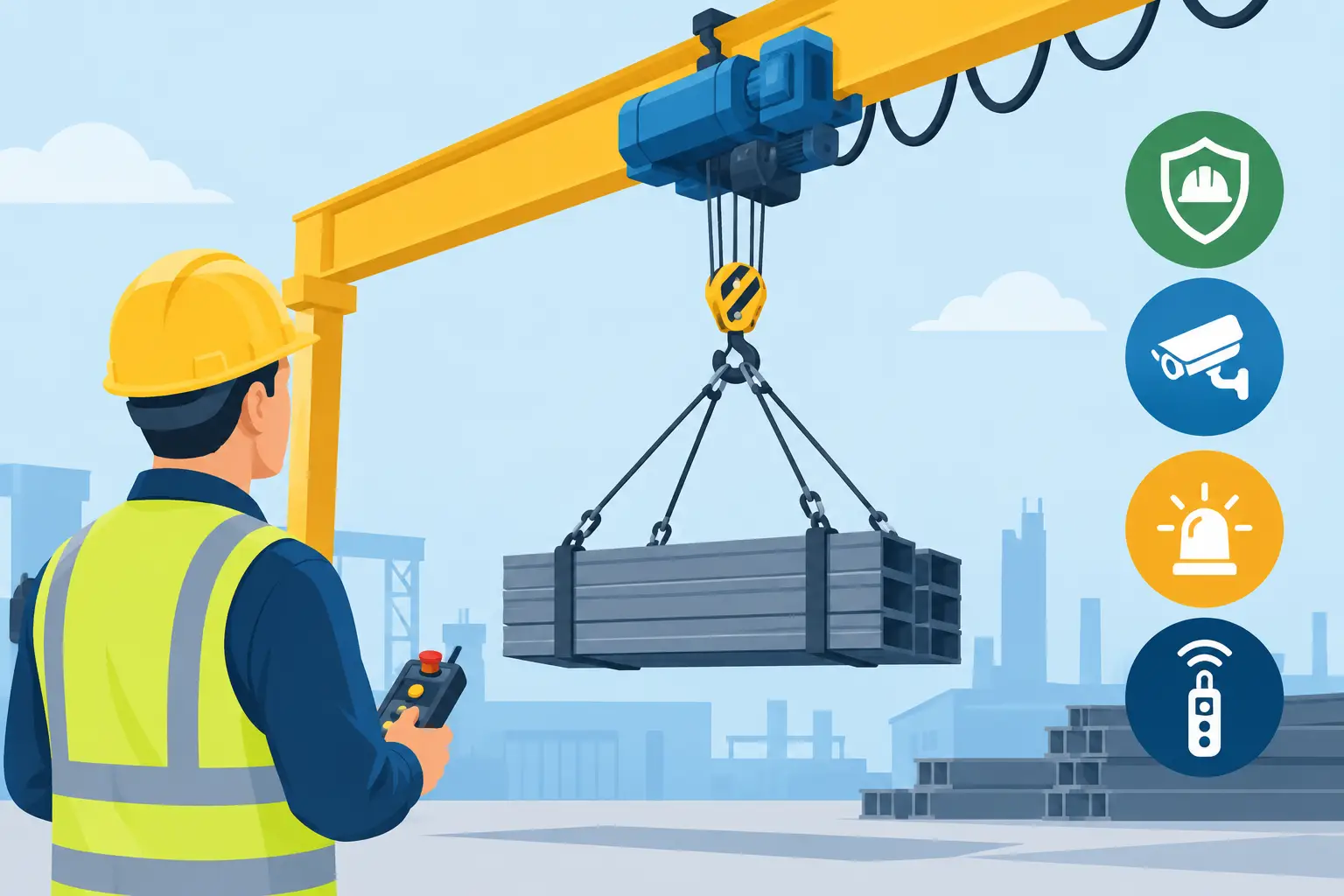
Remote controls can remove an operator from a pinch point, suspended load path or restricted area. They are particularly useful where the best view of the load is not directly beneath the crane runway. A quality radio system should include emergency stop functionality, reliable signal management and a defined procedure for battery charging, handover and fault response.
Remote control is not automatically safer in every application. In a compact workstation, a fixed pendant may give the operator more consistent positioning and prevent unauthorised use. Where pendants remain the best option, upgrades can include improved ergonomic layout, clearer button identification, a longer or better-routed control cable, and a functioning emergency stop that is easy to reach.
Anti-collision systems for shared runways
Two overhead cranes operating on the same runway can create a serious collision risk, especially where production demands frequent cross-travel or operators work from separate positions. Anti-collision systems use sensors to slow or stop cranes before contact, maintaining a controlled separation distance.
This is a high-value upgrade for busy manufacturing bays, but it must be matched to the operating arrangement. The system should account for bridge travel, hoist positioning, variable speeds and any unusual attachments. It also needs functional testing as part of planned maintenance. Anti-collision equipment reduces risk; it does not remove the need for competent operation and site rules.
Overload protection and load indication
Overloading places stress on the hoist, rope or chain, brakes, structure and runway. An overload device prevents a lift beyond the rated capacity, while a load display gives the operator a clear indication of the weight being handled. Together, these upgrades are valuable where loads vary, lifting accessories are frequently changed or weights are estimated rather than controlled.
A load indicator should not replace a confirmed load weight or a lift plan for complex work. It is an operational safeguard, not a licence to guess. The crane safe working load must remain clearly marked, and all lifting accessories still need to be selected, inspected and used correctly.
Variable-speed drives and controlled motion
Older contactor-controlled cranes can start and stop abruptly. That increases load swing, makes accurate placement harder and can cause shock loading on the crane and its supporting structure. Inverter or variable-speed drive upgrades allow smoother acceleration and deceleration on hoist, cross-travel and long-travel motions.
The safety benefit is often immediate: operators gain greater control, loads are less likely to swing into machinery or people, and delicate components can be positioned more accurately. There is also a production benefit where repetitive lifts are slowing down assembly or fabrication work. However, drives must be correctly specified for the crane duty, motor condition and electrical supply. Poor settings can trade smooth movement for reduced performance or unexpected stopping behaviour.
Travel limits, zoning and hook-height protection
Limit switches are simple devices with a significant job. Hoisting upper and lower limits help prevent over-hoisting or running the rope or chain beyond its safe travel. Travel limits can stop a crane or hoist before it enters a restricted area, strikes an end stop or fouls equipment below.
Zoning is useful where parts of a bay must be protected, such as automated machinery, maintenance platforms, racking or pedestrian access routes. It can prevent the crane from travelling into defined areas or limit hook movement when a hazard is present. The design needs careful thought. A badly planned zone can obstruct legitimate work, encourage operators to bypass controls or create confusion during abnormal operations.
Brake, hoist and rope-condition upgrades
A crane is only as safe as its ability to hold and control a load. Brake wear, incorrect adjustment, contaminated components and ageing electrical controls can lead to drift, poor stopping distances or unreliable holding. Upgrading brakes, rectifiers, contactors or hoist controls may be the most important safety investment on an older crane, even though it is less visible than a new remote control.
The same applies to wire rope, chain, hook assemblies and sheaves. These components require examination and replacement based on condition, manufacturer guidance and usage, not simply age. If your crane has persistent brake faults, rope damage or hoist reliability issues, a targeted refurbishment may be more appropriate than adding new control technology to an unreliable lifting unit.
Warning devices, lighting and operator visibility
Audible alarms, flashing beacons and travel warning lights can make crane movements more apparent in noisy or congested workplaces. A projected warning light may help indicate the path or position of the hook, while improved task lighting can reduce errors during precise lifting.
These measures work best as part of a wider traffic-management approach. They cannot make it acceptable to travel loads over people or rely on workers hearing an alarm in a loud fabrication shop. Marked exclusion areas, clear lifting procedures and supervision remain essential.
Do not overlook the runway and electrical system
A crane upgrade can expose weaknesses elsewhere in the installation. Worn runway wheels, misalignment, deteriorated conductor systems, damaged festoon cables or inadequate isolators can affect safe operation and create recurring downtime. If a new drive or higher-duty hoist is being considered, confirm that the runway, electrics and supporting steelwork are suitable for the revised operating demands.
This is also the point to review access for inspection and maintenance. Engineers need safe access to brakes, panels, motors, end carriages and runway equipment. An upgrade that cannot be inspected or maintained efficiently will soon become another operational problem.
How to prioritise crane safety upgrades
Prioritise hazards with the highest potential consequence first: uncontrolled loads, collisions, overloading, inadequate braking and unsafe operator positions. Then consider upgrades that improve repeatability and reduce the chance of human error, such as controlled speeds, improved controls and travel zoning.
Avoid selecting equipment from a catalogue without a site assessment. The correct specification depends on crane manufacturer, model, age, duty classification, lifting height, control voltage, operating environment and the way your team uses the equipment. Compatibility matters, particularly where older cranes have been modified over time.
A planned programme is normally more cost-effective than waiting for a failed examination or breakdown. It allows works to be scheduled around production, parts to be sourced correctly and testing to be completed before the crane returns to service. Following any significant alteration, ensure the required inspection, testing and certification are completed and retained with your LOLER records.
For sites across Yorkshire, the Midlands and the North of England, CraneCert can assess the condition of existing lifting equipment and recommend practical upgrades alongside planned maintenance and statutory examinations. The useful next step is to walk the lifting route with the people who operate it: the risks they work around every shift will usually show where investment will make the greatest difference.