Safe Load Testing Procedures for Overhead Cranes
Safe load testing procedures for overhead cranes: plan the test, control risk, protect production and maintain the evidence needed for LOLER compliance.
CraneCert · 1 November 2026
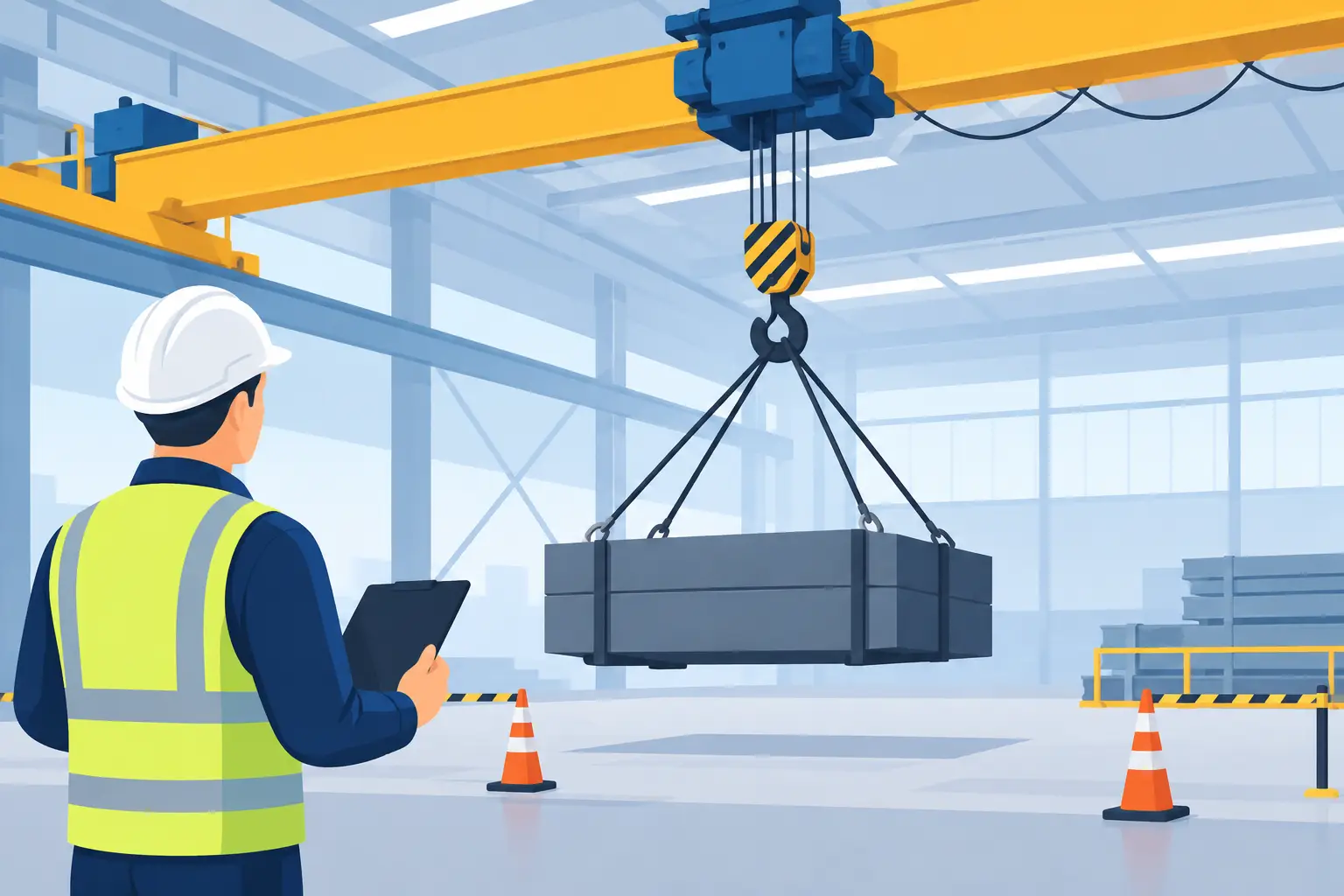
A load test is not a routine lift with a heavier-than-usual item on the hook. It is a controlled engineering activity that can expose people, the crane structure and the building to serious risk if it is improvised. Safe load testing procedures protect your workforce, establish whether equipment is fit for its intended duty and create the evidence needed when an auditor, insurer or competent person asks how the crane has been assessed.
For facilities and engineering managers, the objective is clear: complete the test without creating an incident, damaging an asset or losing more production time than necessary. That requires a defined scope, competent people, suitable test loads and an exclusion zone that is enforced from start to finish.
Safe load testing procedures start with the scope
Before a load is selected or a pendant is switched on, establish exactly what is being tested and why. An overhead crane, hoist, runway, supporting steelwork and lifting accessories form a system. Testing one part without considering the rest can give a false sense of security.
The scope should identify the crane make and model, safe working load, span, lifting height, duty cycle, control method, hoist arrangement and location. It should also record any recent repair, alteration, relocation, collision, overload event or change in use. A crane that has received a replacement brake is not necessarily subject to the same testing requirement as one with a modified hoist structure or altered runway.
The test plan must also define the acceptance criteria. This may include safe operation of upper and lower limits, brakes, motion controls, overload protection, structural deflection where applicable, and the condition of the hook, rope or chain. Do not use a load test to investigate an unresolved fault. If there is abnormal noise, brake slip, damaged rope, poor travel or a suspected structural defect, take the crane out of service and inspect it first.
When is a load test required?
A load test is not automatically required at every LOLER thorough examination. Thorough examination and load testing are different activities. A competent person carrying out a LOLER examination may require testing where it is necessary to establish the safety of lifting equipment, but the right approach depends on the equipment, its history and the reason for assessment.
Testing may be appropriate following installation, substantial alteration, certain repairs, a significant incident or an exceptional circumstance that could affect safe operation. Manufacturer instructions, relevant British Standards, the design information and the findings of the competent person should inform the decision.
Do not confuse proof testing with routine checks
Pre-use checks, planned maintenance, functional tests and LOLER thorough examinations all have different purposes. A daily operator check may identify a damaged pendant or faulty limit switch. Planned maintenance addresses wear before it causes failure. A thorough examination provides an independent assessment at the required interval. A proof or load test applies a controlled load to demonstrate specified performance.
Trying to use one process in place of another creates a compliance gap. It can also create unnecessary downtime and stress on ageing equipment. The question is not simply, “When was it last load tested?” It is, “What evidence do we need to show this crane is safe for its current use?”
Build the test plan around real site conditions
A safe test is planned around the actual bay, not an ideal drawing. Production layouts change, pedestrian routes develop around machines and stored materials reduce clear space. Walk the area before the test and confirm that the runway, crane travel path and landing area are clear.
The appointed person or competent test team should determine the test method, test load and sequence. Test weights must be known, marked and verified. Do not estimate the weight of a fabricated item, use loose scrap or rely on a lorry driver’s description of a load. Where multiple weights are used, their combined mass and the weight of every lifting accessory must be included.
The lifting accessories used to connect the test load must be suitable, in date for examination where required, correctly rated and compatible with the hook. Consider sling angles, hook throat capacity, centre of gravity and whether the load can rotate. A test load that is secure on the floor can become unstable once suspended.
Your written plan should cover at least these four operational controls:
- the defined test area, barriers and method of preventing entry;
- named roles, including the person in charge, crane operator, banksman and emergency contact;
- the route, lift height, travel movements and points where the test will pause for inspection; and
- the action to take if the crane behaves unexpectedly, the load becomes unstable or someone enters the exclusion zone.
Schedule the work when the bay can be controlled. Testing beside active production, forklift traffic or contractor activity raises risk quickly. A short, planned outage is usually cheaper than an uncontrolled interruption following a near miss or damaged crane.
Control the test area before lifting
The load must never travel over people. Set a physical exclusion zone that accounts for the full crane travel path, potential load swing and the area beneath the test load. Cones alone may not be enough in a busy factory. Use barriers, clear signage and direct communication with supervisors whose teams could enter the area.
Brief everyone involved. The operator needs to understand the sequence and must have authority to stop the test. The banksman needs a clear position with visibility of the load and no need to stand beneath it. The person leading the work must be able to halt production activity that conflicts with the plan.
Check environmental and site factors as well. Poor lighting makes it harder to inspect rope seating and hook movement. Wet floors can affect personnel movement. Outdoor gantry or portal crane testing introduces wind, ground conditions and visibility risks. For radio-controlled cranes, confirm the control is assigned correctly and that emergency-stop functions operate as intended.
Carry out the test in a controlled sequence
Start with a visual inspection and no-load functional checks. Confirm that the emergency stop, travel controls, hoist limits and brakes respond correctly. Check the hook block, rope or chain, reeving, drum and lower limit before attaching the test load.
Lift slowly and only high enough to confirm the load is stable and the brake is holding. Avoid shock loading. Sudden starts, stops or snatching can apply forces beyond the intended test conditions and tell you little about normal controlled operation. The crane should be moved through the planned motions at a controlled speed, with the load kept as low as practicable.
Observe the crane throughout. Watch for brake creep, unusual vibration, excessive deflection, skewing, wheel slip, abnormal sound, poor response from controls or movement in the runway and supporting structure. Stop immediately if anything is outside the agreed criteria. Do not continue in the hope that the issue will settle once the equipment warms up.
After the load is landed and made safe, inspect the relevant components again. Some defects are only visible after the applied load has been removed, including rope damage, distorted hooks, loose fasteners or signs of structural stress.
Keep evidence that stands up to scrutiny
A safe test is only complete when its records are complete. The documentation should identify the equipment, location, date, reason for testing, test method, test load, personnel involved, observations, defects and final outcome. It should also state any restrictions on use and whether further repair, examination or engineering review is required.
Keep the record with the crane’s maintenance history, LOLER reports, repair details and certificates for associated lifting accessories. Cloud-managed records make it easier to retrieve the right evidence during an audit, after an incident or when responsibility changes hands. They also help maintenance teams spot repeat faults rather than treating each call-out as an isolated event.
If defects are found, make the status unambiguous. Tagging, isolation and clear communication matter. A crane that has failed a test or requires further assessment must not return to production because the shift is under pressure.
Use specialist support where the risk justifies it
The right test arrangement depends on crane capacity, configuration, age, modification history and site constraints. A compact jib crane in a controlled workshop presents different issues from a double-girder overhead crane serving a high-output fabrication bay. Where the consequences of failure are significant, bring in competent lifting-equipment engineers who can assess the full system rather than simply supply weights.
CraneCert can support planned testing, inspections, repairs and audit-ready certification across the North of England, helping sites keep lifting equipment compliant without losing sight of production continuity. The best time to plan a safe load test is before an alteration, urgent repair or audit turns it into a rushed job.