Predictive Crane Maintenance That Cuts Downtime
Predictive crane maintenance finds wear before failure, protects lifting safety, supports compliance and reduces costly production downtime at your site.
CraneCert · 30 October 2026
A crane rarely fails at a convenient time. It stops during a critical lift, holds up a production line or leaves a loaded component where it cannot safely be moved. Predictive crane maintenance is designed to reduce that risk by identifying deterioration early, before a developing fault becomes an unsafe lift or an expensive breakdown.
For facilities and engineering managers, the value is straightforward: fewer unplanned stoppages, better control of maintenance spend and clearer evidence that lifting equipment is being managed properly. It is not a replacement for LOLER thorough examinations, PUWER duties or planned servicing. It is the layer that helps you act sooner between those essential compliance activities.
What predictive crane maintenance changes
Traditional maintenance is often reactive or calendar-based. A reactive approach means repairs begin after a fault has already interrupted operations. A planned servicing regime is far better, but a calendar alone cannot always show how hard a particular crane, hoist or brake has been working between visits.
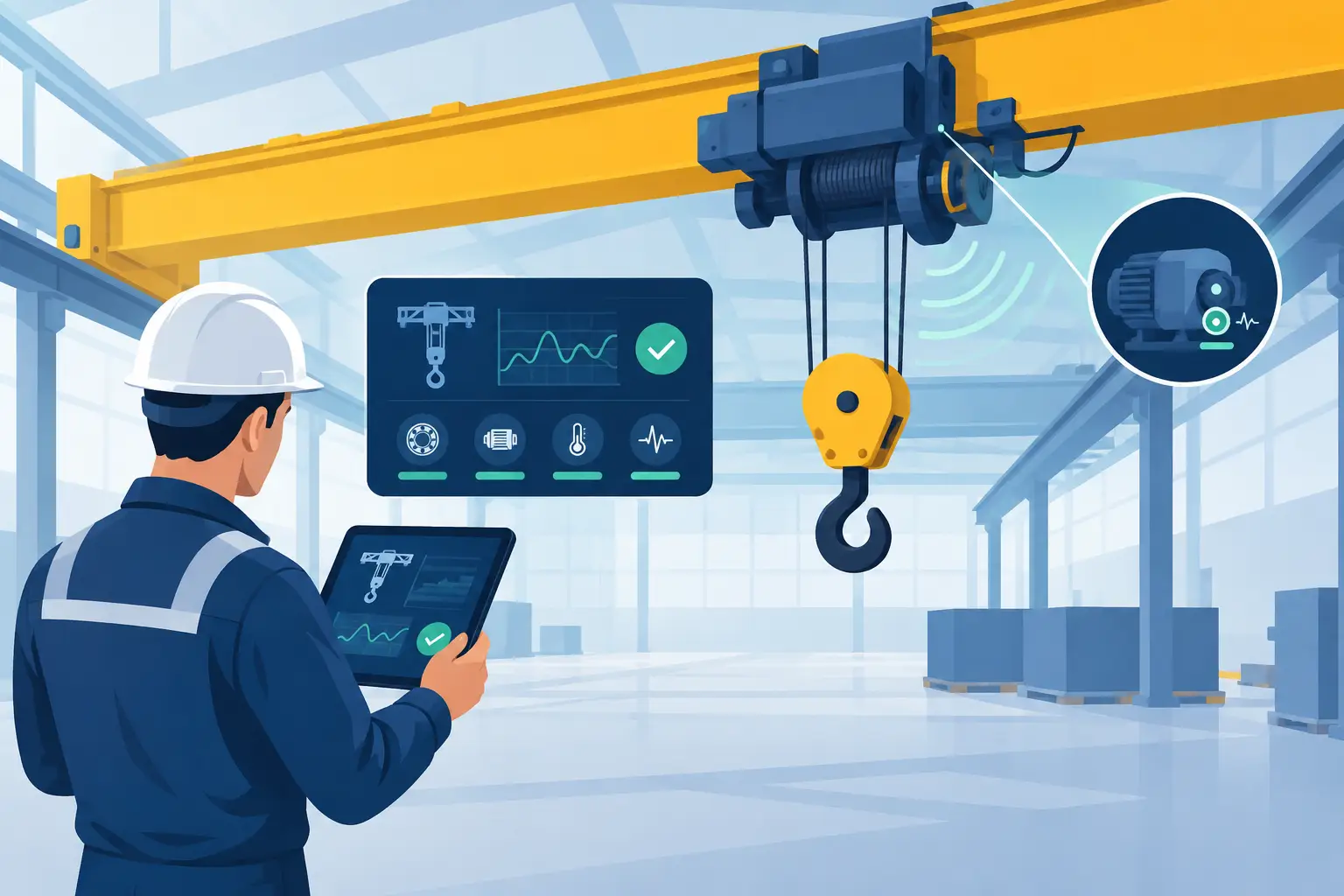
Predictive maintenance uses condition information to guide the work. That information may come from engineer inspections, duty-cycle records, fault histories, operator reports, control-system data or installed monitoring equipment. The objective is to spot abnormal patterns: a hoist motor drawing more current than usual, a brake taking longer to respond, repeated overload events or increasing wear in rope, sheaves, wheels and bearings.
This matters most where a crane is central to output. In a fabrication bay, for example, a hoist failure can halt material flow across several workstations. In a warehouse or industrial yard, an unreliable crane can delay dispatches, create unsafe workarounds and put pressure on staff to keep lifting with equipment that should be isolated.
Predictive work gives the maintenance team time to plan a safe intervention. Parts can be sourced, access arranged and the repair scheduled around production where possible. That is usually far less disruptive than a breakdown call-out after the crane has stopped completely.
Predictive crane maintenance starts with the right risk picture
Not every crane needs the same level of monitoring. A lightly used jib crane in a maintenance workshop has different risks from a double-girder overhead crane completing repetitive, high-capacity lifts over a production line. The right approach depends on the consequence of failure, the crane's age, condition, duty cycle, environment and availability of a suitable backup lifting arrangement.
Start by reviewing the equipment that creates the greatest operational exposure. Consider its safe working load, lift frequency, operating hours, historical faults, load spectrum and whether it handles people-critical, high-value or difficult-to-replace materials. A crane exposed to heat, dust, moisture, corrosive processes or outdoor conditions will also need closer attention because those environments accelerate wear.
The result should be a clear maintenance priority, not a generic sensor package fitted to every asset. For some cranes, improved inspection records and targeted servicing will be enough. For heavily used or ageing equipment, condition monitoring can provide earlier warning and stronger evidence for repair or upgrade decisions.
The warning signs worth tracking
Many serious crane faults begin as small, measurable changes. An experienced engineer can often detect these during a planned visit, particularly when the service history is complete and previous readings are available for comparison.
Common indicators include unusual noise or vibration from gearboxes and bearings, brake wear or inconsistent stopping performance, overheating motors, damaged rope, increased electrical faults, worn collector systems and irregular travel movement. Repeated inverter trips, limit-switch issues and control pendant faults also deserve attention. They may appear minor in isolation, but recurring defects can indicate a deeper issue with usage, adjustment, contamination or ageing components.
Hoists need particular focus because they carry the load. Rope condition, reeving, drum grooves, hook wear, brake performance and upper and lower limit operation all affect lifting safety. Travel components matter too. Worn wheels, rails, end carriages and buffers can cause poor tracking, excessive loading and damage that becomes progressively more expensive to correct.
Operators are a useful source of early intelligence. A simple reporting route for changes in noise, movement, stopping distance or control response can prevent faults being normalised. The key is to record reports, assess them promptly and close the loop with a documented repair or finding.
Build condition checks into the maintenance plan
A practical programme combines statutory inspection, routine servicing and condition-led actions. LOLER thorough examinations must still be completed at the required intervals or under a written scheme of examination, and defects must be managed properly. PUWER also requires work equipment to be maintained in an efficient state, in efficient working order and in good repair.
Predictive maintenance supports these duties, but it does not alter them. A sensor reading is not a LOLER certificate, and a dashboard does not replace a competent person's thorough examination. The strongest approach uses all three layers together: examination for statutory assurance, planned maintenance for routine reliability and condition data to identify emerging faults.
For critical cranes, the plan should define what is checked, how often it is reviewed, who is responsible and what triggers action. That can include baseline readings after installation or major repair, trend checks at service visits, agreed tolerances for abnormal readings and an escalation process where safety or reliability is affected.
It should also state how downtime will be managed. If a defect is found, can the work be completed during a planned shutdown? Is there a spare hoist, alternative lifting route or temporary handling method? Are common wear parts held locally or available quickly? These are commercial as well as engineering questions, because a well-diagnosed fault still causes disruption if the repair cannot be delivered promptly.
Turn data into decisions, not more administration
Condition monitoring generates value only when someone reviews it and acts. Sites can quickly collect fault codes, running hours and inspection notes, then lose the benefit because the information is held across paper reports, spreadsheets and separate maintenance systems.
A useful record should show the crane's service history, defects, repairs, examination status, certificates and outstanding actions in one auditable trail. This gives maintenance managers a clearer basis for deciding whether to repair, refurbish or replace an asset. It also makes audit preparation less dependent on chasing paperwork after the event.
Trend data is especially valuable when budgeting. If a hoist has recurring brake adjustments, frequent electrical faults and increasing downtime, a planned upgrade may be better value than repeated call-outs. Conversely, where condition checks show stable performance, replacement can be deferred with more confidence.
Where predictive maintenance has limits
Predictive methods are not a guarantee against failure. Sudden electrical component faults, accidental damage, misuse and external events can still put a crane out of service without warning. Monitoring equipment also needs correct installation, sensible alarm thresholds and periodic verification. Poor-quality data can lead to false alarms, missed faults and unnecessary intervention.
There is also a cost judgement. Installing advanced monitoring on an older, low-use crane may not be proportionate if regular servicing and competent inspection already manage the risk effectively. The case becomes stronger when downtime is costly, utilisation is high, the crane is difficult to access or replacement parts have long lead times.
The best programme is therefore proportionate. It focuses attention where equipment condition, lifting risk and production consequence justify it, while keeping the maintenance plan practical for the site.
Make the next intervention planned, not urgent
Predictive crane maintenance works best when it is part of an accountable lifecycle approach: know the asset, record its condition, respond to early warnings and keep compliance evidence available when needed. A local specialist such as CraneCert can help align servicing, LOLER examinations, repairs and condition-led improvements around the way your site actually operates.
The right time to investigate a recurring noise, brake concern or intermittent fault is before the next critical lift turns a manageable defect into lost production and a safety decision nobody wanted to make.