Overhead Crane Servicing That Prevents Downtime
Overhead crane servicing protects people, supports LOLER compliance and cuts avoidable downtime, with planned maintenance and clear service records on site.
CraneCert · 9 October 2026
A crane that still lifts is not necessarily a crane that is safe, compliant or reliable enough for production. Overhead crane servicing identifies wear before it becomes a dropped-load risk, a failed examination or an unexpected stoppage in the middle of a shift. For sites where lifting is central to fabrication, manufacturing, warehousing or maintenance, that is a direct protection for people and output.
The cost of poor servicing is rarely limited to one repair invoice. A failed brake, damaged rope, worn wheel or electrical fault can stop a bay, delay dispatches and leave teams waiting for alternative handling methods. Planned servicing gives you control over those risks, with a documented record that stands up when an auditor, insurer or regulator asks for evidence.
What overhead crane servicing should achieve
Effective servicing is more than a visual check and a signature in a book. It is a practical inspection and maintenance activity that assesses the condition of the crane, hoist, controls and safety devices against how the equipment is actually being used.
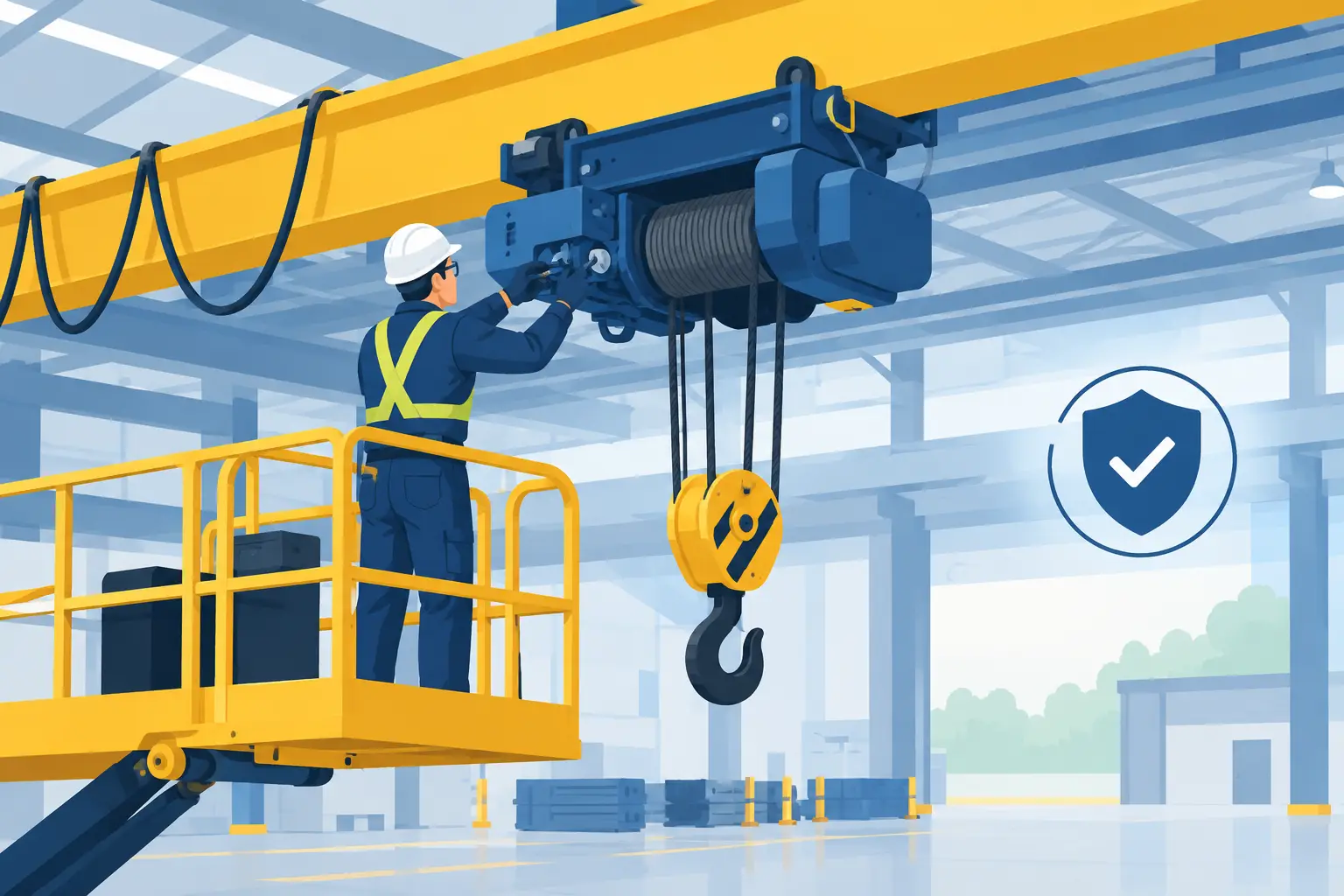
An engineer should look for developing faults in components that affect safe lifting and travel. This includes brakes, wire ropes or chains, hooks, limit switches, pendant controls, festoon systems, electrics, wheels, bearings, gearboxes and runway interfaces. The work may involve adjustment, lubrication, cleaning, testing and replacing worn parts where required.
The right scope depends on the crane. A lightly used jib crane in a clean workshop has different needs from a double-girder crane completing repeated heavy lifts in a dusty fabrication bay. Duty cycle, load weight, operating environment, age, usage patterns, access and manufacturer guidance should all shape the service plan.
The objective is straightforward: keep the equipment safe to use, find deterioration early and avoid repairs becoming emergency breakdowns. That makes servicing a production-control activity as much as an engineering task.
Servicing, LOLER and PUWER are not the same thing
One of the most common compliance gaps is treating a LOLER thorough examination as a maintenance visit. They support each other, but they do different jobs.
A LOLER thorough examination is a formal inspection of lifting equipment and accessories by a competent person. It assesses whether the equipment remains safe for use and identifies defects requiring action. For most lifting equipment used to lift people, examinations are required every six months; equipment lifting goods is commonly examined every 12 months, unless a written scheme of examination sets another interval. The exact requirement must reflect the equipment and its use.
PUWER requires work equipment to be suitable, maintained and inspected where deterioration could create danger. This is where planned service and maintenance are essential. A thorough examination can identify a defect, but it is not designed to replace the regular adjustments, lubrication, functional testing and condition monitoring that prevent defects arising in the first place.
A well-managed site keeps these activities connected. Service reports inform maintenance decisions, repairs are recorded, defects from examinations are closed out promptly, and current certificates are available without searching through paper files. Cloud-managed documentation is particularly useful when several cranes, sites or responsible managers are involved.
When should a crane be serviced?
There is no credible one-size-fits-all interval. Six-monthly servicing may suit some lower-duty applications, while high-use equipment may need quarterly attention or more frequent checks. A crane operating in heat, moisture, abrasive dust, corrosive conditions or around welding fumes may also need closer monitoring than the same model in a clean, dry environment.
The service interval should be based on risk rather than habit. Consider how often the crane operates, typical loads, whether lifts approach rated capacity, how many operators use it, the condition of its runway and whether previous reports show recurring faults. Manufacturer recommendations provide a starting point, but operational reality should decide the final plan.
Between scheduled visits, operators should carry out pre-use checks and report anything unusual. Slow or inconsistent brake performance, damaged pendant cables, abnormal noise, hook distortion, rope damage, erratic travel and repeated tripping are not issues to leave until the next planned visit.
The following signs warrant prompt engineering attention:
- A hoist that drifts, slips or fails to hold a load correctly.
- Unusual vibration, grinding, banging or overheating during travel or lifting.
- Visible damage to wire rope, chain, hook, end stops or electrical cables.
- Limit switches, warning devices or controls that do not operate consistently.
- Repeated faults, nuisance trips or a crane moving differently from normal.
Taking a crane out of service can feel disruptive. Continuing to use equipment with an unresolved safety-critical defect is usually far more disruptive, and potentially far more costly.
What a planned service visit should include
A useful service visit starts before the engineer arrives. The provider should understand the crane type, safe working load, make and model, location, working environment, past faults and any changes to how the crane is used. This allows the visit to focus on the areas most likely to affect reliability and compliance.
On site, the engineer needs safe access to inspect the full system, not only the hoist at floor level. Depending on the crane, that may include the bridge, end carriages, runway, power supply, controls, hoist unit and safety devices. Functional testing should verify that lifting, lowering and travel movements respond correctly and that protective features operate as intended.
The report matters as much as the physical work. It should record the equipment serviced, observations, work completed, defects found, recommended actions and any parts that need replacement. Clear priority categories help a maintenance manager decide what must be isolated immediately, what should be repaired urgently and what can be planned into the next shutdown.
Where a repair is required, ask for clarity on both the immediate fix and the underlying cause. Replacing a failed contactor restores operation; understanding why it failed may prevent the same disruption returning. On ageing equipment, repeated reactive repairs can eventually cost more than a planned hoist replacement, controls upgrade or wider crane modernisation.
Planning servicing around production
The best maintenance plan does not simply meet a calendar date. It works around the way your site operates. A production manager may need work completed during a planned shutdown, at weekends or between shifts. A maintenance manager may need several items of lifting equipment covered in one coordinated visit. In either case, early planning reduces the risk of engineers arriving when equipment cannot be released safely.
It is also worth agreeing what happens when a fault is found. Some defects require immediate isolation, while others can be managed with a scheduled repair and appropriate controls. Your service provider should explain the consequence in plain terms, including whether the crane can remain in use, what restrictions apply and how quickly parts or specialist access can be arranged.
For multi-site businesses, a single service schedule and central document control can reduce administrative pressure. It gives responsible persons visibility of upcoming services, overdue actions, LOLER dates and equipment history, rather than relying on separate local spreadsheets or paper folders.
Choosing a service partner that can respond
A low-cost visit is poor value if the provider cannot support the equipment when it fails. Choose a partner with engineers who can service a range of makes and models, access suitable parts, provide emergency breakdown support and carry out repairs rather than only identifying faults.
Local coverage matters too. When a crane is down, response time affects labour utilisation, delivery commitments and production recovery. For businesses across Yorkshire, the Midlands and the North of England, CraneCert combines planned maintenance with LOLER thorough examinations, PUWER inspections, repairs, upgrades and new-crane capability. This gives sites one accountable route from routine care to a major equipment decision.
Ask how reports are issued, how quickly statutory documentation is available and how defects are tracked to closure. Audit-readiness is not a filing exercise. It is evidence that the business knows what equipment it has, what condition it is in and what action has been taken to keep people safe.
A planned service schedule will not eliminate every failure. Parts wear, operating conditions change and unexpected faults still happen. It does, however, put your site in a far stronger position to spot problems early, plan expenditure and keep lifting equipment available when production needs it most.
The practical next step is to review each crane against its actual duty and service history, then set intervals that reflect the risk. If the records are incomplete, the equipment is ageing or the same faults keep returning, treat that as a maintenance decision that needs attention now, not after the next stopped production line.