Lifting Plan Requirements for Safer Crane Work
Understand lifting plan requirements for safer crane work, clearer responsibilities and better control of risk, compliance and production downtime daily.
CraneCert · 5 November 2026

A lift can look routine right up to the point it goes wrong. A load is heavier than expected, the travel path is obstructed, a sling is selected incorrectly, or two people assume the other has checked the exclusion zone. Clear lifting plan requirements turn those assumptions into controlled decisions before the crane moves.
For factories, workshops, yards and production bays, the plan is not paperwork for paperwork’s sake. It is evidence that the lift has been considered by competent people, that the equipment is suitable and that those involved understand exactly what must happen. It also protects production. A poorly planned lift can damage stock, machinery, building fabric and people, then stop the line while the incident is investigated.
What the law expects from a lifting plan
Under the Lifting Operations and Lifting Equipment Regulations 1998 (LOLER), every lifting operation must be properly planned by a competent person, appropriately supervised and carried out safely. The level of planning must be proportionate to the lift. Moving a known, stable load with a dedicated overhead crane on an established production route does not need the same level of detail as lifting an irregular fabricated vessel through a congested bay.
That said, routine does not mean risk-free. Repetitive lifts should be covered by a documented generic plan or standard operating procedure, reviewed whenever the load, route, equipment, workplace or method changes. Non-routine, complex or higher-risk lifts need a lift-specific plan.
LOLER planning sits alongside duties under PUWER, which require work equipment to be suitable, maintained and used by trained people. A current LOLER thorough examination certificate is essential, but it does not confirm that a particular lifting operation has been planned safely. Nor does a lifting plan remove the need for pre-use checks by operators.
Core lifting plan requirements
A usable lifting plan should allow the people on the shop floor to answer five practical questions: what is being lifted, how will it be lifted, where will it travel, who is in control, and what stops the job if conditions change?
Define the load accurately
Start with the actual load weight, not an estimate taken from a drawing or a previous job. Include lifting beams, spreader frames, hooks, slings, shackles and any other lifting accessories when checking the total load imposed on the crane or hoist.
The plan should also record the load’s dimensions, centre of gravity, lifting points and stability. An off-centre load can rotate sharply once it leaves the floor. Long loads can swing into racks, machines or pedestrians even when their weight is well within the crane’s safe working load.
Where the weight or centre of gravity is uncertain, stop and establish it before lifting. Guesswork is not a control measure. The same applies where lifting lugs have no stated capacity, show signs of damage, or are not positioned to maintain a stable lift.
Confirm the equipment is suitable
The lifting appliance and every accessory must be suitable for the task. This means more than selecting a crane with enough rated capacity. Check the available hook height, hook approach, span coverage, lifting speed, duty cycle and the ability to place the load safely at both pick-up and set-down points.
For an overhead crane, consider whether the trolley can reach the required position without side pulling the hoist. Side pulling can damage rope, drum and brake components, create uncontrolled load movement and place forces on the crane that it was not designed to take.
The plan should identify the required slings and attachments, their working load limits at the intended sling angles, and the protection needed at sharp edges. Sling angle is frequently overlooked. As the angle between sling legs increases, the tension in each leg rises. A sling arrangement suitable for a vertical lift may be overloaded once used at a shallow angle.
Check that the crane, hoist and accessories have current thorough examination status where required, are marked with their safe working loads and have passed pre-use inspection. Damaged chains, distorted hooks, missing safety catches, worn wire rope or illegible identification should be dealt with before the lift, not noted afterwards.
Plan the route and the landing area
The safest route is usually the shortest clear route, but it must be verified rather than assumed. Identify fixed obstructions such as machinery, columns, racking, ducting, doors and crane runway limitations. Consider changing floor levels, poor lighting, restricted visibility and shared pedestrian areas.
The landing area needs as much planning as the lift itself. It must be level, stable, capable of taking the load and prepared with suitable dunnage where needed. The load should be set down without trapping slings, damaging finished surfaces or creating an unstable stack.
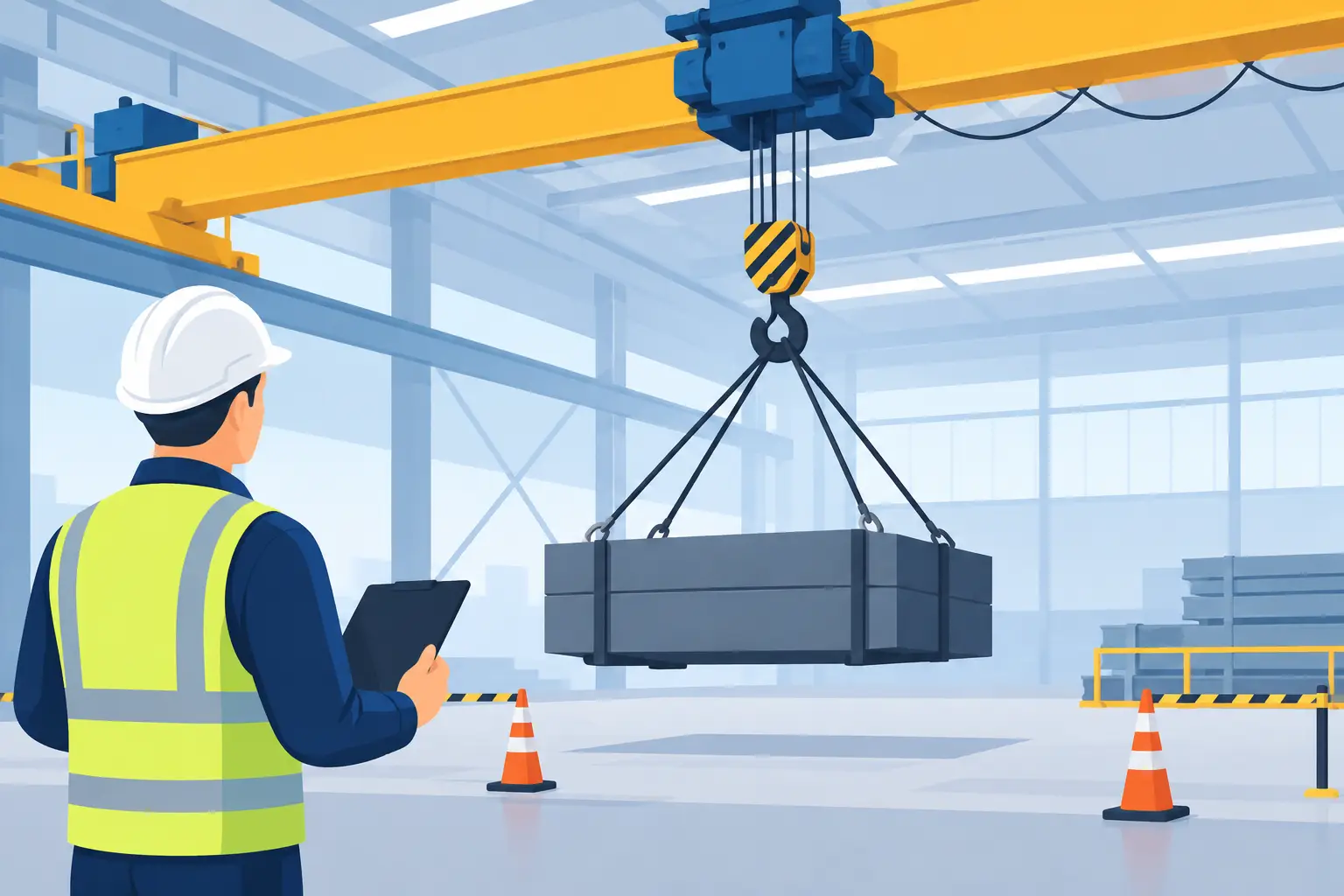
Establish an exclusion zone below and around the suspended load. People should not walk beneath a load or enter its likely swing path. If the lift crosses an active work area, production may need to pause briefly. That interruption is normally far less costly than an injury, collision or emergency repair.
Name the people and their responsibilities
A lifting plan must make responsibility visible. For more complex operations, an appointed person should plan and organise the lift. A crane supervisor should ensure the plan is followed on site, while the crane operator and slinger/signaller carry out their assigned duties.
Titles alone are not enough. The people involved must be competent for the specific equipment and lift method. They need clear communication arrangements, particularly where the operator cannot see the load throughout the movement. Agree the signalling method before the lift begins and nominate one person to give signals. Conflicting instructions are a predictable route to error.
The plan should state who has authority to stop the lift. In practice, anyone who sees an unsafe condition should be able to call stop, with no pressure to continue because a delivery is waiting or a machine is down.
Set out controls for changing conditions
A good plan includes the conditions that make the lift unacceptable. These may include poor visibility, loss of communication, a damaged accessory, an unexpected obstruction, people entering the exclusion zone or a load that does not lift evenly.
For external yard lifts, wind, rain, ground conditions and overhead services may all affect the method. For indoor overhead crane work, the key variables are often access, load security, crane availability and whether another crane is operating in the same bay.
Where two cranes are used to lift one load, or loads are transferred between lifting appliances, the operation needs detailed control. The load share, movement sequence, communication, travel limits and emergency arrangements must be defined. Tandem lifts should never be treated as an informal extension of normal crane work.
When does a routine lift need a new plan?
A generic plan is useful for repetitive work, but it has limits. Review it when there is a new load type, altered weight, different lifting points, changed route, modified crane, replacement hoist, revised layout or a change in the people carrying out the work.
The same applies after an incident, near miss or equipment defect. Repeating the old method because it has worked before can preserve the condition that caused the problem. Review findings with operators and maintenance teams, then amend the plan and brief affected personnel.
Ageing equipment also changes the risk picture. A crane may remain serviceable, but repeated faults, worn controls, poor braking performance or limited spare-parts availability can affect whether it is appropriate for a critical lift. Planned maintenance and prompt repair are part of maintaining safe lifting operations, not separate concerns.
Make the plan usable at the point of work
A lengthy document that stays in an office file will not control a lift. The plan should be clear enough for the team to use at the job, with the critical details easy to find: load weight, lifting method, equipment, route, exclusion zone, named roles and stop-work conditions.
Brief the team before the operation, especially if the lift is unusual or the work area is busy. Confirm that the crane operator knows the route, the slinger knows the attachment method and the supervisor has checked the area. If a change is proposed midway through the task, pause and reassess rather than improvising.
Cloud-held certificates and inspection records help here. They make it quicker to confirm examination status, identify assets and demonstrate control during an audit. CraneCert supports customers with planned maintenance, LOLER thorough examinations and practical lifting-equipment advice so compliance records support safe work rather than becoming a last-minute scramble.
The strongest lifting plans are not the longest. They are the ones that make the safe method obvious, give people permission to stop when something changes and keep the crane available for the work that matters next.