Choosing Crane Refurbishment Versus Replacement
Crane refurbishment versus replacement: assess safety, compliance, downtime and whole-life cost before you commit capital or risk production delays.
CraneCert · 3 November 2026
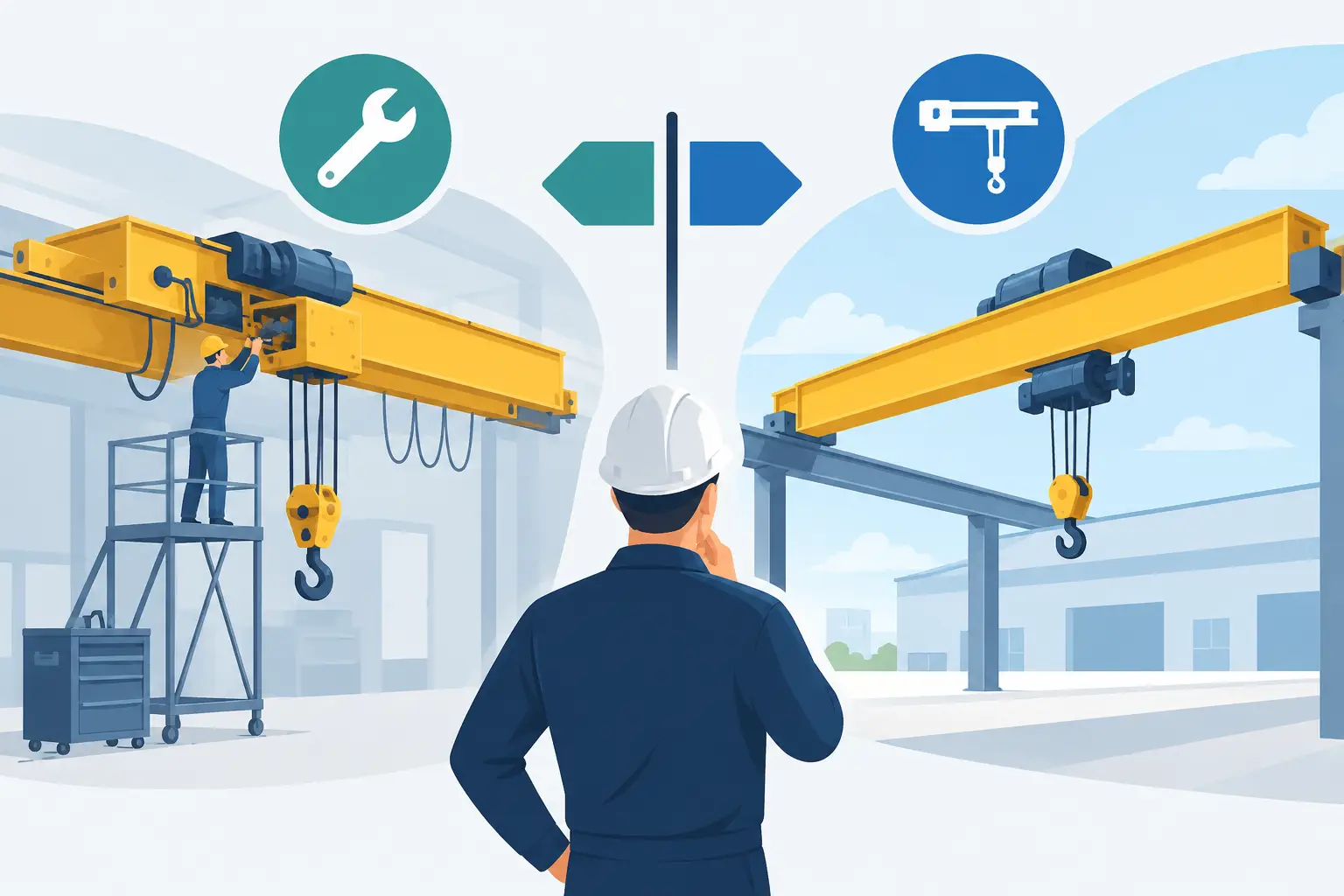
A crane that still lifts is not necessarily a crane that is fit for the work your business now demands. When weighing up crane refurbishment versus replacement, the decision is rarely just about the age of the equipment or the price of a new installation. It is about whether the crane can continue to operate safely, remain compliant and support production without becoming a source of costly downtime.
For facilities and engineering managers, the wrong decision can create two problems at once. Spend too little on an ageing crane and repeated breakdowns, failed examinations or restricted lifting capacity begin to affect output. Replace too soon and capital is tied up in equipment that may have had years of useful life remaining. A proper assessment puts safety and statutory compliance first, then tests the commercial case against the reality of your operation.
Crane refurbishment versus replacement: where to start
Start with evidence, not assumptions. Review the crane's service history, breakdown records, LOLER thorough examination reports, PUWER findings and the condition of the runway, electrics, hoist, controls and safety devices. A single fault does not automatically justify replacement. Equally, a passed thorough examination does not mean the crane is the most reliable or productive asset for the job.
The key question is whether the existing structure and main mechanical components remain fundamentally sound. If the bridge, end carriages, runway interface and hoist arrangement are suitable, refurbishment may provide a practical route to safer, more dependable lifting. If there is structural deterioration, a major mismatch between crane capacity and current loads, or a layout that restricts production, replacement often offers better long-term value.
Duty cycle matters as much as age. A crane used occasionally for maintenance lifts is a different proposition from one making frequent production lifts across every shift. Two cranes installed in the same year can be in very different condition depending on load spectrum, operating environment, maintenance quality and operator use.
When refurbishment is the right investment
Refurbishment is most effective when it removes identifiable reliability or compliance risks without attempting to make an unsuitable crane do a job it was never designed to perform. It can be a sensible option for well-built systems where the main steelwork remains serviceable but components have reached the end of their economic life.
Typical refurbishment work may include replacing a worn hoist, modernising pendant or radio controls, renewing festoon systems, upgrading electrical panels, fitting variable speed drives, replacing brakes or wheels, and improving limit switches and overload protection. These works can improve positioning, reduce component failures and bring safety features closer to current expectations.
It is also a useful route where production cannot accommodate a long installation programme. Planned refurbishment can often be staged around shutdowns, weekends or quieter periods, reducing the impact on manufacturing. The works should still be properly planned, with lifting arrangements, isolation procedures, testing and documentation built into the programme.
A refurbished crane should not be treated as a short-term patch simply because it costs less than new equipment. The work needs a defined scope, clear condition findings and realistic expectations for remaining service life. If critical components are changed but recurring defects remain elsewhere, the business may only defer a larger problem.
Signs refurbishment may be appropriate
Refurbishment is usually worth investigating where the crane has a sound structure, its current safe working load remains suitable, and faults are concentrated in replaceable components. It may also suit a site where headroom, span and hook approach already work well for the process, but reliability and control need improvement.
The financial case strengthens when the cost of works is materially lower than replacement and the expected reliability improvement can be demonstrated. This should include avoided downtime, not simply the price of parts and labour. A hoist failure that stops a production bay for a shift can cost more than the repair itself.
When crane replacement is the safer commercial decision
Replacement becomes the stronger option when the crane no longer matches the operation. Perhaps the loads have increased, a new machine layout needs greater hook coverage, or operators need better control over delicate or high-value components. Retrofitting can only go so far if the original crane design is the constraint.
Structural concerns demand particular care. Corrosion, fatigue, distortion, repeated wheel or rail issues and defects affecting the bridge or end carriages require competent investigation. Continuing to invest in ancillary parts without resolving an underlying structural issue can expose the business to unacceptable safety and availability risk.
Replacement is also worth considering where obsolete controls or hoist components are difficult to source, where breakdown attendance is becoming frequent, or where maintenance costs are rising without delivering dependable performance. The decision should be based on whole-life cost rather than the immediate purchase price. A new crane may reduce reactive call-outs, improve energy use, provide more accurate handling and give clearer maintenance visibility for years ahead.
New equipment also allows the installation to be designed around the actual lifting task. Capacity, span, headroom, hook approach, travel speeds, duty classification, controls and access for maintenance can all be assessed before manufacture. That is especially valuable where production has evolved since the original crane was installed.
Do not overlook the runway and supporting structure
A replacement crane project is not solely a crane purchase. The runway beams, rails, columns and building structure must be assessed for suitability, particularly where capacity is increasing or duty is changing. Electrical supply, isolation arrangements, access and the operational layout also need to be considered.
This wider review can reveal that a like-for-like replacement is not the best answer. A different configuration, such as a double-girder crane for improved headroom, a jib crane to serve a workstation, or a revised lifting arrangement to reduce unnecessary travel, may improve the entire process.
Build the decision around risk and production continuity
The practical way to compare options is to model what each route means for the next five to ten years. Include planned maintenance, expected repairs, availability of spares, outage time, examination findings, energy use and the cost of lost production. If your operation relies on one crane, the effect of a failure is greater than at a site with alternative lifting capacity.
Compliance must sit within that assessment. LOLER requires lifting equipment to be thoroughly examined at the appropriate intervals, while PUWER requires work equipment to be suitable, maintained and used safely. Neither regulation tells you to replace an old crane simply because of its age. They do require you to control the risks associated with its condition and use.
Good records make the decision more defensible. Inspection reports, repair history, defect trends and certification should be available when management, insurers, customers or auditors ask for evidence. Cloud-managed records can make it easier to spot repeated issues before they become a breakdown or a failed examination.
Avoid making the choice immediately after an emergency failure unless the equipment is clearly beyond economical repair. Emergency decisions are sometimes necessary, but a quick assessment of parts availability, repair scope, safety implications and likely remaining life can prevent an expensive short-term response from becoming a poor long-term investment.
A planned assessment gives you control
The strongest outcome is often neither a full replacement nor a minimal repair. It may be a phased plan: address immediate safety defects, refurbish the components that cause downtime, then schedule replacement when production and budget allow. This gives operations a clearer path than repeatedly authorising reactive repairs.
CraneCert can assess equipment across makes and models, review inspection and maintenance history, and advise whether refurbishment, upgrade or a new crane system best protects your people and output. The objective is not to sell the largest project. It is to establish a safe, compliant lifting arrangement that your site can rely on.
If the crane is becoming harder to maintain, causing disruption or no longer fitting the work beneath it, do not wait for the next breakdown to make the decision. A planned technical review gives you time to choose the right investment on your terms, while keeping lifting operations controlled and production moving.