Jib Crane Installation Requirements for Safe Lifting
Jib crane installation requirements: foundations, structural checks, clearances, electrics, testing and certification for safe, compliant lifting work.
CraneCert · 20 October 2026
A jib crane can solve a handling bottleneck in one production bay without the cost or disruption of a full overhead crane system. But jib crane installation requirements must be addressed before equipment is ordered, not when the installers arrive on site. The wrong foundation, inadequate steelwork or a missed clearance can turn a straightforward project into lost production time, remedial building work and an asset that cannot be put into service.
For facilities and engineering managers, the objective is clear: install a crane that is safe for the people using it, suitable for the loads and duty cycle, and supported by evidence that stands up to a LOLER or PUWER audit. That requires a proper survey, sound engineering decisions and commissioning by competent people.
Jib crane installation requirements start with the application
The crane specification should follow the actual lifting task. Capacity alone is not enough. A 250 kg jib used occasionally to position light components has very different requirements from a 1 tonne jib repeatedly feeding machinery throughout a shift.
Start by defining the maximum lifted load, including lifting accessories, below-the-hook equipment and any handling fixture. This establishes the required safe working load, but the load position matters too. On a jib, the greatest overturning force is normally created when the trolley and load are at the outer end of the arm. The support structure and foundation must be designed for that worst-case moment, not simply for the stated lifting capacity.
The planning information should also cover:
- required arm length and usable working area;
- hook height, headroom and the height of the load at pick-up and set-down;
- lift frequency, operating hours and expected duty cycle;
- load type, including whether it is awkward, hot, fragile or likely to swing; and
- the operator position, pedestrian routes, vehicles, machinery and restricted areas below the lifting zone.
A longer arm gives greater coverage, but it also increases forces at the base or wall bracket. Higher capacity may require heavier steelwork, a deeper foundation or a different crane arrangement. In tight workshops, a shorter arm with a better location can be safer and more productive than specifying the largest possible working radius.
Choose the right support arrangement
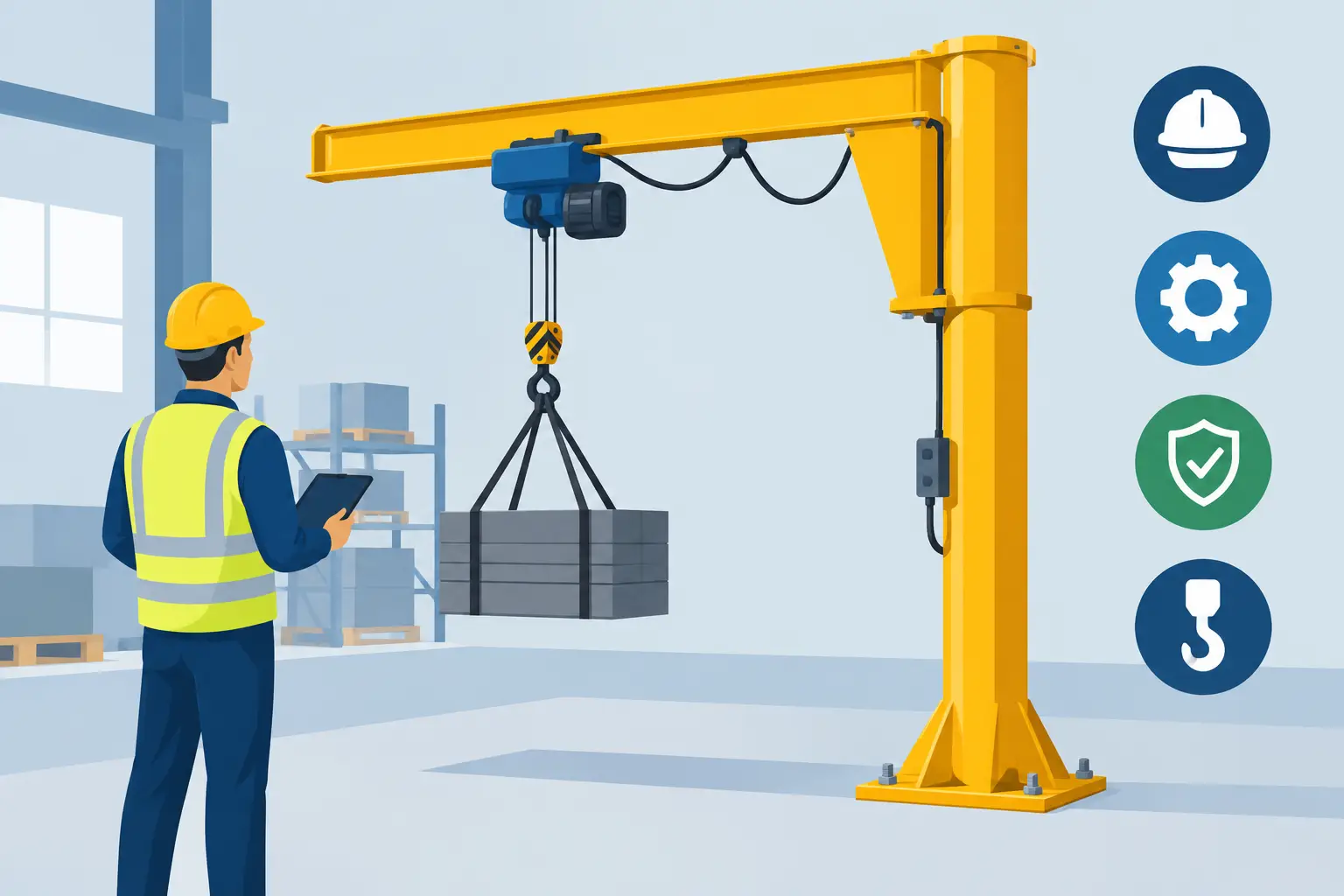
Most jib cranes are free-standing, wall-mounted or mast-type. Each has different installation conditions.
A free-standing pillar jib is independent of the building structure, but it relies on a purpose-designed reinforced concrete foundation or an existing slab that has been verified as suitable. A standard warehouse slab is not automatically adequate. Slabs vary widely in thickness, reinforcement, condition and proximity to joints, pits, drains or services. Drilling and fitting anchors without a foundation assessment is not an acceptable shortcut.
The crane supplier or structural engineer should confirm the base loads, foundation dimensions, reinforcement detail and anchor arrangement for the proposed crane. They should also consider ground bearing capacity where a new foundation is needed. Concrete requires sufficient curing time before the crane can be installed and loaded, so this needs to be built into the project programme.
Wall-mounted jibs save floor space and can provide useful local coverage, but their loads are transferred into the building frame. The selected column, wall or gantry steel must be assessed for vertical load, horizontal load, torsion and repeated use. Masonry walls, cladding rails and unverified building columns should never be treated as crane supports. If the existing structure is unsuitable, purpose-designed supporting steelwork may be the right answer.
Mast-type jibs can use a combination of floor and overhead support. They can be useful where a free-standing foundation is impractical, but they still require a verified load path into the building. The decision should be based on the building survey, lift pattern and available headroom, rather than the initial purchase price alone.
Check clearance before committing to the layout
A jib crane needs more than an open patch of floor. The boom must rotate through its intended arc without striking racking, process equipment, roller shutters, lighting, cable containment, sprinkler pipework or another crane. The suspended load also needs a clear route.
Measure the available height from finished floor level to the lowest obstruction. Then allow for the jib beam depth, trolley, hoist body, hook dimensions and the required hook approach. A crane that can reach the load but cannot lift it high enough to clear the machine table or stillage will not deliver the expected operational benefit.
Rotation stops may be needed to prevent the boom entering an unsafe area. In some applications, it is better to restrict the slewing range than to rely on an operator stopping at the right point every time. Consider whether the load can pass over people, workstations or access routes. Lifting operations should be organised to avoid this wherever reasonably practicable.
The survey should also consider forklift traffic. A pillar positioned close to a vehicle route needs physical protection from impact, such as suitable barriers or bollards designed so they do not interfere with crane operation. Damage to a jib base, mast or bracket can compromise the installation even when the crane itself appears undamaged.
Electrical supply and controls need planning
Electric chain hoists, powered trolleys and powered slew options require a correctly specified electrical installation. Confirm the voltage, phase, isolator location, cable route, earthing and protection arrangements before installation day. The isolator must be accessible for maintenance and emergency isolation, without placing a person in the lifting zone.
Cable systems must allow full jib movement without snagging, excessive tension or exposure to damage. Where the crane operates in a harsh environment, the electrical specification may need to address dust, moisture, heat, corrosive atmospheres or washdown. A standard arrangement may not be suitable for every fabrication shop, foundry or external yard.
Controls should support safe handling. The pendant position, cable length and operator standing area should be assessed so the user can see the load and remain clear of crush points. If a radio control is proposed, it must be suitable for the application and managed so that only authorised users operate the crane.
Installation, testing and certification before use
Installation work should be planned as a controlled lifting and engineering activity in its own right. This includes site access, delivery arrangements, unloading, exclusion zones, work at height, isolation of nearby plant and control of contractors. Where applicable, the client and contractors must meet their duties under the Construction (Design and Management) Regulations.
Once installed, the crane must be checked against the approved design and manufacturer instructions. Fasteners, anchors, welds, slew mechanisms, end stops, hoist limits, brakes, electrical functions and warning devices all require inspection. The safe working load must be clearly marked and any operating restrictions made obvious to users.
Under LOLER, lifting equipment must receive a thorough examination by a competent person before it is first put into service where safety depends on the installation conditions. This is particularly relevant to jib cranes, as their safety is closely linked to the integrity of the foundation, building structure and anchorage. A report of thorough examination should be available before operational use, alongside installation records and relevant test evidence.
PUWER also requires work equipment to be suitable, maintained and used by people who have received appropriate information, instruction and training. Do not treat the certificate as the final step. Operators need to understand the crane's safe working load, lifting accessories, pre-use checks, travel path, emergency stop and the limits of the crane's intended use.
Plan for inspection and maintenance from day one
A jib crane is easier to keep compliant when future access has been considered at the design stage. Hoist maintenance, brake checks, electrical fault-finding and thorough examinations all need safe access. If a mobile access platform is required, check that it can reach the equipment without obstructing production or creating a conflict with racking and machinery.
The examination interval should be established according to the equipment and how it is used. Many lifting appliances require thorough examination at least every 12 months, although a written scheme of examination may set a different interval where appropriate. Lifting accessories generally require more frequent examination. Planned servicing between examinations helps identify wear, loose fixings, damaged controls and hoist issues before they cause downtime or a failed inspection.
Keep the documentation together: design information, structural verification, installation records, commissioning details, LOLER reports, maintenance history and repairs. Cloud-managed records make it far easier to show control during an audit and to act quickly when an item needs attention.
A correctly installed jib crane should become a reliable part of the production process, not a future compliance problem. Before ordering, arrange a competent site survey that tests the structure, space, lifting duty and access against the real job. That early decision protects people, avoids expensive alterations and gives the crane the best chance of keeping work moving for years to come.