Double Girder Crane Applications That Need Capacity
Double girder crane applications demand safe capacity, long spans and dependable duty performance. See where they fit and what to specify for compliance.
CraneCert · 22 October 2026
A 20-tonne fabrication assembly cannot wait while a marginal crane is taken out of service, nor can an ageing runway tolerate a new lifting system chosen on capacity alone. Double girder crane applications are typically found where load weight, building span, lifting height or working frequency make a lighter arrangement a poor operational fit. The right specification protects people, preserves output and gives duty holders clear evidence that lifting operations are being properly controlled.
Where Double Girder Crane Applications Make Sense
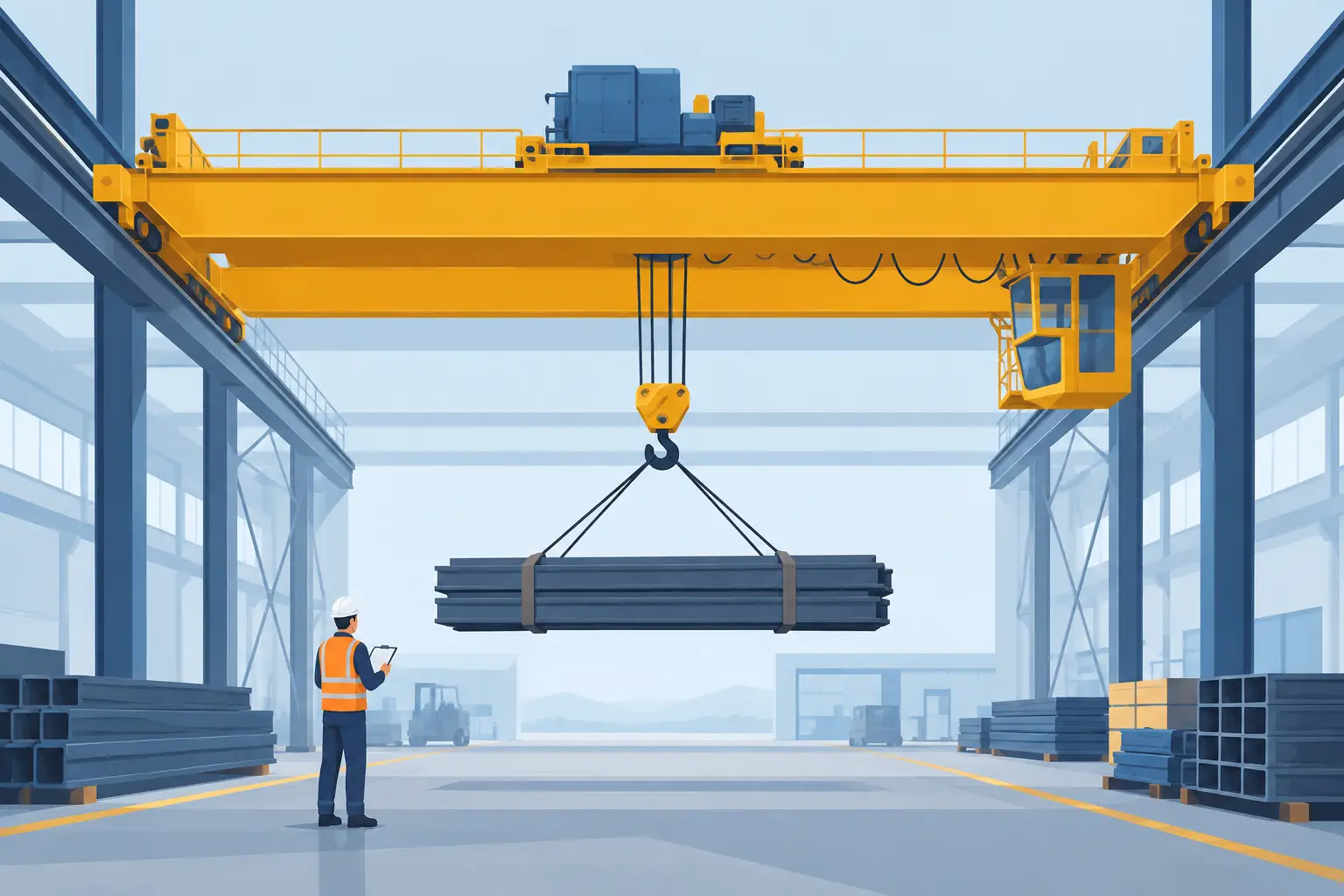
A double girder overhead crane has two bridge girders running on end carriages along the runway beams. The hoist trolley travels between or on top of those girders, depending on the design. This arrangement generally provides more lifting height, a greater safe working load potential and better support for long spans than a single girder crane.
That does not mean a double girder crane is automatically the best answer for every heavy load. A well-specified single girder crane may be more economical for moderate capacities, shorter spans and intermittent use. The decision should follow the actual lifting duty, building constraints and future production plans, rather than a preference for the largest possible crane.
Steel fabrication and structural assembly
Fabrication shops are among the most common double girder crane applications. Steel sections, fabricated frames, plate assemblies and completed components can be heavy, long and awkward to control. The crane may need to serve several workstations, load welding beds, turn assemblies with coordinated lifting equipment or present finished items for despatch.
Long spans are often a deciding factor. Where the crane must cover a broad fabrication bay, a double girder design can carry the necessary capacity without compromising practical hook approach. It also suits operations with regular lifting throughout a shift, particularly where a breakdown would immediately stop cutting, welding, assembly or loading activity.
The application still needs careful planning. Long or unstable loads may require spreader beams, lifting beams, twin hooks or a dedicated lifting plan. The crane is only one part of the lifting operation. Attachment points, slinging methods, load control and operator visibility all need to be addressed under LOLER.
Heavy manufacturing and production lines
In production environments, cranes may repeatedly handle press tools, dies, moulds, gearboxes, castings, motors and process equipment. These loads are not always exceptionally heavy, but they are often expensive, difficult to replace and required at precise intervals. A missed lift can hold up an entire production line.
Double girder cranes suit this type of work when high duty, accurate positioning and reliable coverage are required. Variable speed controls, radio remote control, anti-sway features and load monitoring can all improve control, but they should be selected for a defined operational reason. More features do not remove the need for trained operators, clear exclusion zones and planned maintenance.
For plants operating around the clock, duty classification matters as much as rated capacity. A crane that lifts ten tonnes occasionally has a different design requirement from one that repeatedly lifts five tonnes across every shift. Specifying the expected number of lifting cycles, travel distances, average loads and peak loads helps ensure the hoist, motors, brakes and structure are suited to the real task.
Foundries, engineering works and process facilities
Foundries and heavy engineering sites place particular demands on lifting equipment. Heat, dust, vibration, high ambient temperatures and frequent use can shorten component life if they are not considered from the outset. Handling ladles, castings, tooling and furnace-related equipment may also require carefully controlled speeds and additional safety measures.
A double girder crane can provide the structural capacity and headroom needed in these settings, but the environment must drive the specification. Protection for electrical equipment, heat shielding, suitable lubricants, specialist cabling and planned inspection access can be more valuable than a standard configuration with a higher nominal capacity.
The same principle applies to chemical, recycling and waste-processing facilities. Corrosive atmospheres, airborne contaminants and outdoor exposure affect the choice of paint system, electrical enclosure, rope, hook block and control equipment. A crane should be designed for the conditions it will actually experience, not simply for a clean indoor workshop.
Large machinery installation and maintenance
Many sites use an overhead crane only when a machine needs installing, a motor needs changing or a major maintenance shutdown is under way. The lifting frequency may be lower, yet the consequences of a failed lift are substantial. A large CNC bed, compressor, transformer or gearbox may need to pass through tight clearances with limited alternatives for access.
Double girder cranes are often selected where a high hook position is needed to clear plant. Because the hoist can be arranged between the bridge girders, the crane can achieve better vertical lift than some single girder arrangements. This can be the difference between lifting a component clear of a machine and having to dismantle surrounding equipment first.
Check the full lifting envelope before committing to a design. Required height of lift is not just the distance from floor to hook. It must allow for the height of the load, lifting accessories, hook block, clearances and the route needed to remove or install the item safely.
Warehousing, yards and loading operations
Double girder cranes also have a role in warehouses and industrial yards handling large fabricated products, precast units, long stock or heavy equipment. In a covered loading bay, the crane may transfer goods between production, storage and a waiting lorry. In an outdoor yard, a gantry or portal crane may be the more appropriate double girder configuration where there is no suitable building structure or runway support.
Outdoor use introduces additional considerations: wind limits, drainage, corrosion protection, travel end stops, lighting and secure isolation. The operational plan must state when lifting should stop because of weather conditions. A crane able to lift the load in still conditions may not be safe to operate with a large surface-area load in high winds.
Specifying a Double Girder Crane for the Real Job
Capacity is the starting point, not the whole specification. The safe working load must cover the heaviest planned load and any lifting accessories that form part of the lift. It should not be inflated without reason, however, as unnecessary capacity can increase project cost and impose higher loads on the supporting structure.
Span determines the width the crane must cover, while hook approach determines how close it can safely reach to each side of the bay. Headroom identifies the vertical space available above the load. These dimensions need a site survey, particularly in older buildings where roof steelwork, services, lighting and existing runways may limit options.
The runway itself is critical. New cranes are sometimes installed on ageing rails, corroded brackets or building columns that were never assessed for the proposed loads. A competent design review should consider wheel loads, runway alignment, end stops, electrification and the building's ability to support the crane in service, including dynamic forces.
Control arrangement also affects safe use. Pendant control may be suitable where the operator needs to remain close to the load. Radio control can provide better positioning and visibility, but it requires clear operating rules, protected control stations and reliable emergency-stop arrangements. A cabin may be justified for high-duty, long-travel or specialist applications, although it adds cost and maintenance requirements.
Compliance Does Not End at Installation
A new crane must be commissioned, tested as appropriate and handed over with the information needed to use and maintain it safely. Duty holders need to understand the rated capacity, operating limits, inspection points and any restrictions imposed by the design.
Under LOLER, lifting equipment used at work requires thorough examination at the required intervals by a competent person, or in accordance with a written scheme of examination where appropriate. PUWER also requires work equipment to be suitable, maintained and used by people who have received adequate information, instruction and training. These duties apply to the crane, but also to hooks, hoists, lifting accessories and the lifting operation itself.
Records must be available when an auditor, insurer or enforcing authority asks for them. Expired certificates, unresolved defects and unclear ownership of inspections create avoidable exposure. Cloud-managed certification and next-day documentation make it easier for a site team to demonstrate control without searching through paper files during an audit.
Planned maintenance should reflect the crane's environment and duty. A lightly used maintenance crane may need a different schedule from a production crane completing hundreds of cycles each day. Brake condition, wire rope wear, limit switches, wheels, electrical equipment and runway alignment all deserve attention before they become causes of downtime.
When an Upgrade Is Better Than Replacement
Not every operational issue requires a new double girder crane. An existing system may benefit from a hoist replacement, radio controls, variable speed travel, modern electrics, runway repairs or improved load handling equipment. An upgrade can extend useful life and reduce risk, provided the crane structure and supporting runway remain suitable.
Replacement is often the safer commercial decision when capacity requirements have increased, recurring faults are affecting production, parts are obsolete or inspection findings reveal broader deterioration. The cost comparison should include lost output, emergency call-outs, repair lead times and compliance risk, not only the purchase price of a new crane.
For sites across Yorkshire, the Midlands and the North of England, CraneCert can assess both the lifting requirement and the condition of the existing installation. That gives managers a practical basis for deciding whether to repair, upgrade or specify a new system.
Before approving any crane project, walk the intended load route with the people who operate and maintain it. The most effective double girder crane is the one that fits the building, handles the real load safely and remains available when production depends on it.